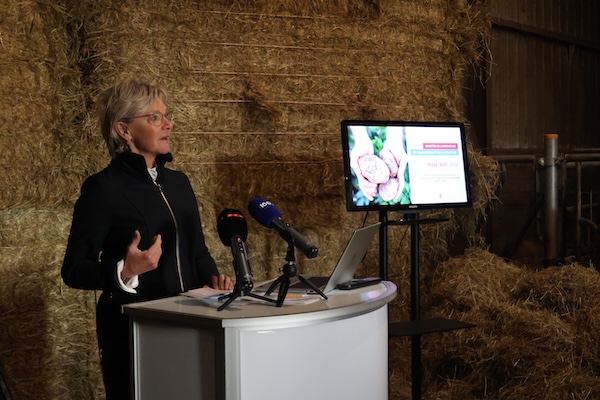
 Martine Hansen, Luxembourg Minister for Agriculture, Food and Viticulture;
Credit: MA
Martine Hansen, Luxembourg Minister for Agriculture, Food and Viticulture;
Credit: MA
On Monday 22 December 2025, Luxembourg’s Ministry of Agriculture, Food and Viticulture presented the National Action Plan for Organic Agriculture – PAN-Bio 2026–2030 at Bio Haff Baltes farm in Stegen.
The ministry said that as the existing action plan (PAN-Bio 2025) is coming to an end the new plan laid solid foundations for the development of the organic sector in Luxembourg and firmly anchored the topic in public debate.
The ministry added that although PAN-Bio 2025 did not fully achieve all of its ambitions, it nevertheless played a decisive role in structuring the sector, raising public awareness and professionalising supply chains. These advances now form a solid basis on which PAN-Bio 2030 builds. PAN-Bio 2030 continues this work while taking into account lessons learned and recommendations put forward by national stakeholders. The plan is more targeted, more realistic and better aligned with new national and European dynamics.
According to the ministry, PAN-Bio 2030 sets a clear objective: to increase the certified organic utilised agricultural area by 1% each year, reaching approximately 15% by the end of 2030. This objective, based on recent trends, aims for realistic growth aligned with the current capacities of the sector.
A key pillar of the plan focuses on promoting partial conversion, supported by a targeted training framework. The plan will offer training courses to producers to inform them about the potential for conversion, the practical modalities involved and what is feasible in terms of production within a partial conversion model. This approach will make it possible to gradually increase organic production. In parallel, specific training courses will target advisers, enabling them to identify farms with potential for partial or full conversion and to support them effectively throughout the process. This approach will help identify farms with the capacity to meet demand for certain highly sought-after products, particularly in collective catering, while guaranteeing outlets for those products.
The plan also adopts a resolutely practical approach, focused on the concrete development of value chains for the benefit of the organic sector.
The ministry emphasised that PAN-Bio 2030 fully aligns with national objectives for sustainable food systems. By 2030, eighty per cent of the products used by the collective catering organisation Restopolis will come from Luxembourg agriculture. Of these, thirty per cent will come from organic farming.
The ministry said: “This ambitious objective directly supports producers and strengthens coherence between production, processing and consumption. At the same time, targeted actions will increase the supply of local and organic products across all collective catering structures.”
The plan is structured around four strategic pillars, each accompanied by concrete measures, responsible stakeholders and an implementation timetable:
• creating favourable framework conditions for the expansion of organic farming;
• supporting and accompanying producers during conversion and long-term maintenance;
• strengthening value chains and commercial outlets;
• promoting consumption and ensuring effective governance.
Martine Hansen, Luxembourg Minister for Agriculture, Food and Viticulture, stated: “PAN-Bio 2030 marks a new stage for organic agriculture in Luxembourg. By building on lessons from the past and working hand in hand with stakeholders in the sector, we are equipping ourselves to move forward in a realistic and ambitious manner. Partial conversion and collective catering objectives offer solid prospects for strengthening organic farming in Luxembourg for the benefit of both producers and consumers.”
Bio Haff Baltes is a family-run farm, taken over and developed by Daniel Baltes and his wife Myriam. It began its full conversion to organic farming in 2000. In 2005, the farm set itself the goal of becoming Luxembourg’s first producer of organic goat’s cheese. The on-site artisanal dairy was established and marketed its first organic cheeses made from the farm’s own goat’s milk in 2007. Bio Haff Baltes currently has approximately 250 dairy goats, Limousin beef cattle and Icelandic horses. Of the 118 hectares farmed in Luxembourg, the land is mainly used for various cereals, legumes and other fodder crops, as well as grassland.