Ahead of the International Day for the Eradication of Poverty on 17 October 2015, STATEC today published its traditional 'Work and Social Cohesion' report, showing that employment increased 16% between 2008 and 2014.
The increase manifested despite the economic and financial crisis of 2009, which led to a significant slowing in employment in Luxembourg. Between 2009 and 2015, however, employment continued to rise at an averga 2.1%, against an annual average of 3.4% between 2000 and 2008. At the euro zone level, employment decreased at an annual average of 0.3% from 2009 to 2014, against a positive evolution of 1.0% yearly from 2000 to 2008. Whilst the increase in employment in Luxembourg was largely due to cross-border employment before the crisis, from 2008 this factor stabilised at 42% of domestic employment.
The employment rate of Luxembourg residents was also found to have stayed on the rise, growing from 71.1% in 2013 to 72.1% the following year. This represented a significant growth from the early 2000s, when the rate stood at only 67.5% and is due to an increase from 53.8% in 2000 to 63.9% in 2013 of female employment. Last year this rate was shown to have further risen, passing 65.5%. The employment of women is a factor which Luxembourg has this year stated as a priority.
For men, the employment rate is slowing slightly in the medium term, having passed from 80.8% in 2000 to 78.4% in 2014 and hovering around 78% for the past four years. On the other hand, the unemployment rate, calculated according to the standards of the International Labour Office (ILO), rose from 4.4% of the active population in 2010 to peak at 5.9% in 2013, remaining at that level in 2014. Despite this, Luxembourg holds the third lowest unemployment rate in the European Union, after Germany and Austria at 5.1% and 5.7%, respectively.
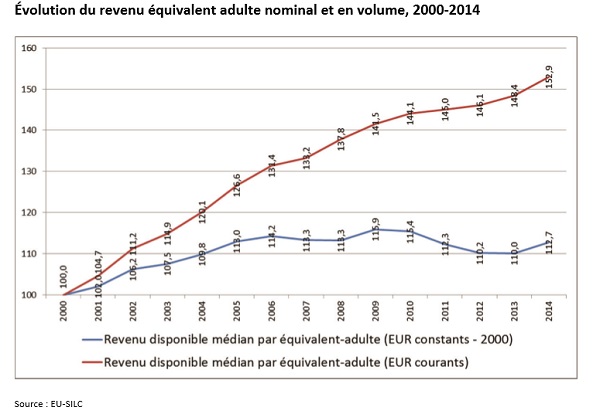
The standard of living was reported by STATEC to have slowed sinced the beginning of the crisis, making a recovery in 2014. The nominal median income continued to increase in recent years, but was not as levels capable of compensating th eloss of purchasing power caused by inflation.
In 2013, the median adult income in equivalent volume, constituted in terms of purchasing power, was 5% below its 2009 level, whilst in nominal value it was 5% higher than in 2009. Last year, the median standard of living was on the increase again for the first time since the beginning of the crisis.
Labour income constitutes 66.9%, or two-thirds, and therefore represents the most important element of the overall household income. But in 2012, the average wage in Luxembourg, in terms of purchasing power, was still at 3% below its level of 2009. In 2013 and 2014, the evolution of the real average wage regained growth, of +1.9% in 2013 and +1.2% in 2014.
Despite the rate of poverty risk and social exclusion was stable at 19% from 2013 to 2014, this figure is still above its 2009 level. One of the objectives of the EU 2020 strategy is the reduction of poverty and social exclusion, identifying three dimensions to define those at risk: the risk of income poverty, severe material deprivation and the share of people living in households with low work intensity.
Photo by STATEC