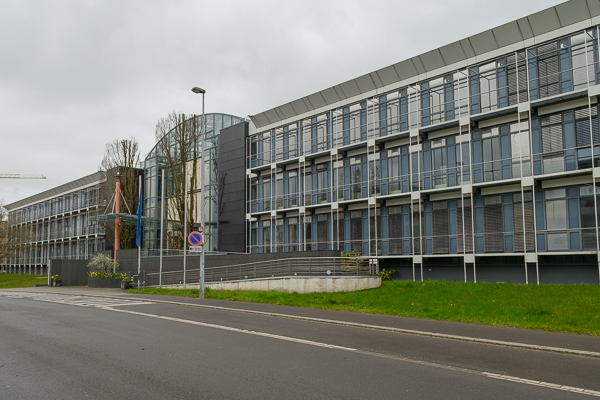
 Euroforum building in Luxembourg-Gasperich;
Credit: Ali Sahib, Chronicle.lu
Euroforum building in Luxembourg-Gasperich;
Credit: Ali Sahib, Chronicle.lu
Chronicle.lu has compiled a new series of articles dedicated to European institutions, bodies and agencies with a presence in Luxembourg.
Standing alongside Brussels in Belgium and Strasbourg in France, Luxembourg City is one of the European Union’s three official seats. A founding member of the European Union (EU), Luxembourg is known internationally as a business and financial hub and hosts several major EU institutions and other bodies.
Based mainly in Luxembourg-Kirchberg, these institutions shape European law, finance and democratic processes and employ around 15,000 international professionals.
Throughout this series, Chronicle.lu will introduce the main European institutions, bodies and agencies in Luxembourg and explain how they work. This article focuses on EURATOM.
The European Atomic Energy Community (EAEC or EURATOM) is an international organisation which was established following the signing of two treaties on 25 March 1957 - the treaty establishing the European Economic Community (EEC) and the treaty establishing the European Atomic Energy Community (EAEC or Euratom).
The Treaty on the European Atomic Energy Community came into force on 1 January 1958 and its purpose is to promote research, disseminate technical information, set uniform safety standards to protect the public and industry workers, facilitate research and to ensure civil nuclear materials are not diverted to other uses, particularly military applications.
EURATOM is legally distinct from the European Union and, although it is governed by many of the EU's institutions, it is, uniquely, the only remaining community organisation that is independent of the European Union and therefore outside the regulatory control of the European Parliament.
The treaty applies to all 27 countries of the European Union, with participation from Switzerland through various agreements, particularly in the area of nuclear research. The United Kingdom ceased to be a full member of the organisation following the end of the Brexit transition period on 31 December 2020. However, it does participate in the treaty as an associated state.
Since its inception, EURATOM has harmonised nuclear safety rules, introduced safeguards against nuclear proliferation, provided leadership in fusion research, secured nuclear fuel supply systems and coordinated nuclear research across Europe.
The Euratom Supply Agency (ESA) is based at the Euroforum building in Luxembourg-Gasperich, where its primary role is to guarantee a regular and equitable supply of nuclear materials (uranium, thorium, enriched uranium) to EU nuclear power producers. It also supports EU energy security policies and ensures compliance with international nuclear safeguards.
According to its 2024 annual report, the Euratom Supply Agency (ESA) continues to play a key role in ensuring the secure and diversified supply of nuclear materials across the European Union. The agency, which operates with a budget of €270,000 fully financed by the EU, recorded 259 transactions in 2024, reflecting a 17% increase compared to the previous year. Its work focuses on monitoring market developments, reducing dependence on external suppliers and supporting the long-term security of the EU’s nuclear fuel supply.
Outside of Luxembourg, the Joint Research Centre (JRC), primarily based in Ispra (Italy), also plays a key role in supporting the work of EURATOM. It provides independent scientific and technical support for EU policies, including nuclear safety and energy research. Its activities in relation to EURATOM include undertaking studies on nuclear reactor safety, radiation protection and radioactive waste management, supporting EURATOM in setting safety standards and implementing nuclear safeguards and publishing data and reports for EURATOM-related issues.
One high-profile project involving EURATOM is the creation of the International Fusion Reactor (ITER) in Saint‑Paul‑lez‑Durance in southern France. ITER is a global scientific collaboration funded by the EU, the US, Russia, China, Japan, India and South Korea. It is a proof-of-concept experiment designed to create an energy source through the process of nuclear fusion (the process through which the Sun generates energy). Nuclear fusion, unlike the process of nuclear fission utilised by current nuclear power stations, has the potential to create more energy than is needed to operate the reactor, while producing no carbon emissions or radioactive waste. The technology developed at ITER is intended for use in future fusion reactors, worldwide.
As well as developing safer methods for the management of nuclear waste, other projects funded by EURATOM include the decommissioning of older nuclear facilities in locations such as Visaginas (Lithuania), Kozloduy (Bulgaria) and Jaslovské Bohunice (Slovakia). Each of these decommissioning projects was instigated as part of each respective country’s EU accession commitments.
EURATOM often works in conjunction with the International Atomic Energy Agency (IAEA), an intergovernmental organisation consisting of 178 member states, which promotes the peaceful use of nuclear energy and prevents its use for military purposes, including nuclear weapons. Also founded in 1957, it serves as the world’s central forum for scientific and technical cooperation in the nuclear field.
EURATOM does not hold regular meetings like the EU parliament. Instead, its work is coordinated through EU institutions, primarily the European Commission in Brussels (Belgium), which handles EURATOM’s administration, research programmes and provides regulatory oversight. On occasion, administrative and legal matters linked to EURATOM treaties may be dealt with in Luxembourg.