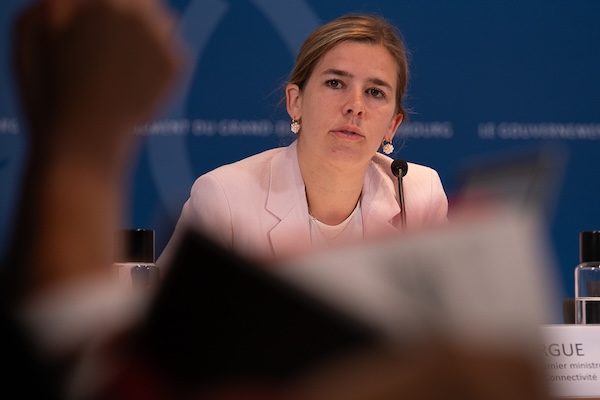
 Elisabeth Margue, Luxembourg's Minister of Justice;
Credit: Ali Sahib, Chronicle.lu
Elisabeth Margue, Luxembourg's Minister of Justice;
Credit: Ali Sahib, Chronicle.lu
On Friday 3 July 2026, Luxembourg's Ministry of Justice reported that the government had approved a draft law introducing an accelerated court appearance procedure aimed at delivering a faster and more effective criminal justice response to certain offences.
According to the ministry, the government approved the draft law on the proposal of Luxembourg's Minister of Justice, Elisabeth Margue. Alongside increasing the number of judges and prosecutors, the proposed legislation represents a key measure to reduce the time required to process criminal cases.
Minister Margue, said: "To ensure a faster, more effective and better-adapted criminal justice response to certain forms of crime, it is necessary to adapt the existing procedural mechanisms."
The procedure may be applied when a suspect is caught in the act and the subsequent investigation has produced serious evidence of guilt, and the public prosecutor considers that there is no need to open a formal judicial investigation.
To ensure the effectiveness of the new procedure, the draft law provides for the possibility of placing the person concerned in pre-trial detention until their court appearance. However, this measure would remain subject to a decision by an investigating judge and strict conditions, including the seriousness of the offence, the risk of absconding, the risk of evidence being altered or the risk of reoffending.
The ministry stressed that the proposal fully preserves defence rights and procedural safeguards. The person concerned must be informed of the allegations, heard by an investigating judge before any detention decision is taken and has the right to legal representation. They will also have access to the case file and retain the right to request release at any stage of the proceedings.
The draft law was prepared in close cooperation with the judicial authorities and representatives of the Luxembourg Bar Associations to ensure it meets the practical needs of legal professionals while providing a more effective judicial response to crime, greater protection for citizens and respect for defence rights.
The ministry noted that the accelerated court appearance procedure forms part of a broader strategy to modernise criminal justice policy and strengthen the operational capacities of the judicial authorities and the Grand Ducal Police, particularly in response to organised crime and drug trafficking.
Several legislative reforms have already been introduced or adopted in recent months, notably under the Drogendësch 2.0interministerial action plan. These include the law of 19 December 2025, which expanded the use of special surveillance measures beyond terrorism to other serious crimes, including human trafficking, drug trafficking and certain offences involving the sexual exploitation of minors, providing authorities with tools better suited to technological developments and increasingly sophisticated criminal networks.
The ministry also recalled that the law of 12 December 2025 introduced measures to improve the efficiency of criminal investigations, particularly in combating money laundering, while amending the rules governing suspended prison sentences to make it easier to impose custodial sentences in the most serious cases, such as violent offences.
It further highlighted Bill No. 8757, submitted to the Chamber of Deputies on 3 June 2026, which proposes additional powers for the Grand Ducal Police and the Public Prosecutor's Office to combat drug-related crime, including new offences relating to hidden compartments in vehicles and other means of transport used to conceal drugs, weapons, illicit goods or criminal proceeds, as well as several procedural amendments designed to strengthen criminal investigations.
According to the ministry, the draft law reflects the government's commitment to combating crime through a firm and swift criminal justice response while protecting citizens and upholding the fundamental principles of the rule of law