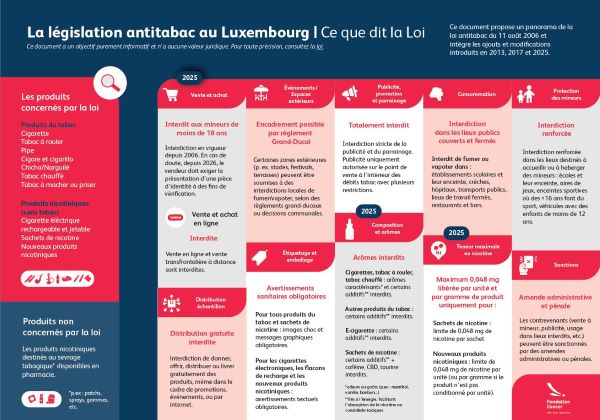
On Wednesday 7 January 2026, Luxembourg’s Fondation Cancer released an explanatory infographic to help the public understand the country’s updated tobacco control law and the new regulations applicable to each type of product.
The Law of 28 November 2025 amending the amended law of 11 August 2006 on tobacco control entered into force on 1 January 2026. The new legislation strengthens the regulation of tobacco, nicotine pouches and new nicotine products, and aligns heated tobacco products with the rules governing traditional cigarettes.
New measures for nicotine pouches and new nicotine products include:
• a maximum content of 0.048 mg of nicotine per pouch, per unit or per gram;
• a ban on the use of nicotine products in areas frequented by young people, such as schools, playgrounds and other public spaces;
• the prohibition of additives such as caffeine, taurine, CBD and other substances that facilitate nicotine absorption or are associated with energy-boosting or relaxation effects.
The new law states that heated tobacco products are now subject to the same rules as traditional cigarettes, particularly regarding flavours and health warnings.
The law also prohibits the sale and purchase of such products to minors under the age of eighteen. In case of doubt, since 2026, sellers must request the presentation of an identity document for age verification purposes.
With this new adaptation, the law of 11 August 2006 has undergone its third major amendment after those of 2013 and 2017. To help to clarify the anti-tobacco law in the version applicable in 2026, Fondation Cancer has released an illustrated summary in the form of an infographic which:
• presents all tobacco products and nicotine products;
• explains the rules applicable to each category;
• offers a clear and accessible overview of the current regulations.
In addition to targeting the general public, this tool is intended especially for professionals, municipalities and schools.
The infographic is available for download on maviesanstabac.lu.
According to the NGO, this law represents “significant progress”, although the organisation points out that certain products, particularly disposable electronic cigarettes, remain highly attractive to young people and will require additional measures.