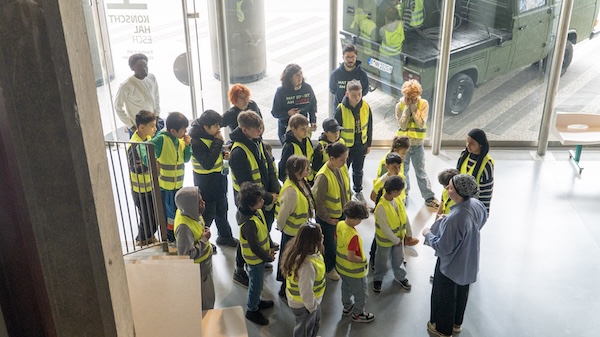
 Credit: Sportunity Asbl
The Sportunity Asbl, a Luxembourg-based NGO fostering social inclusion through sport and wellbeing, supports around 285 refugee participants each year, with more than 40% female participation, through initiatives including weekly training sessions, intercultural programmes and free holiday camps for children from refugee and displaced families, provided at no cost to participants.
Chronicle.lu spoke with Eryn Zander, Founder and CEO Sportunity, about the organisation’s activities and its holiday camps for children, which aim to provide safe, inclusive spaces through sport.
Chronicle.lu: Could you tell us more about the work of Sportunity in Luxembourg, its main mission and key areas of activity?
Eryn Zander: Sportunity was founded in Luxembourg in 2013 and has recently marked its thirteenth anniversary. Our mission is to use sport as a tool for social inclusion, particularly for refugees. Our core activities include weekly training sessions, intercultural programmes, corporate engagement initiatives and holiday camps for children. We work across a wide range of sports and formats, with a focus on creating meaningful connections between refugees and the wider community. Each year, we reach around 285 refugee participants, with over 40% female participation.
Chronicle.lu: How did the idea of organising holiday camps for children come about, and how has this project developed since 2022?
Eryn Zander: It came from a very practical observation: school holidays are genuinely difficult for refugee families. Most activities stop, there’s very little on offer, and children who are already navigating a new country, a new language and a new school suddenly have weeks with nothing structured to do. The isolation can be real.
Our first camp started in 2023 from a single private donation, a one-off gift that gave us the chance to test the concept. It worked, and we made it a permanent part of what we do. We now run several camps a year, tied to the school holiday calendar. Most recently, we completed our Easter camp, and we are already preparing for the Pentecost holidays. The programme has evolved a great deal in content and ambition, but it remains centred around keeping children active and helping them discover the world around them.
Chronicle.lu: Were the holiday camps initially aimed at children from Ukrainian families who arrived due to the war, and how has the target group evolved over time?
Eryn Zander: We have always worked with vulnerable families of refugee origin across many nationalities, and that hasn’t changed. What is true is that when we launched the camps, there was significant demand from Ukrainian families, and Ukrainian children made up a large part of our camp participants in those early editions. More recently, we are seeing a much more mixed group, which we actively encourage, as the diversity within the group enhances the cultural learning experiences of the children in the camp.
Chronicle.lu: What types of activities are offered to children during these camps?
Eryn Zander: Every camp follows the same underlying logic: sport every day to keep children active, combined with discovery activities that vary from edition to edition. That might be a museum visit, something in nature, a science workshop or a creative atelier. We try to bring in variety so that children who come back encounter something new each time.
One thing we have been developing, and that we are particularly excited about for 2026, is bringing in remarkable personalities, people with inspiring life stories and diverse paths, to meet with the children directly. When a child can speak with someone who has done something extraordinary, or who has navigated real adversity and built something meaningful, it opens up a sense of what is possible. We want children to be able to see, with their own eyes, that different futures exist. That is a thread running through this year’s camps and the next.
Chronicle.lu: What age groups are the camps designed for, and do you organise children into different groups based on age?
Eryn Zander: We work with children between eight and fourteen. We do not split them into separate age groups or run differentiated activities. Instead, we mix them deliberately. What we do is pair older children with younger ones, so the older ones become informal mentors within the group. They grasp things faster naturally, but then they help bring the younger children along. It is a way of building responsibility and care into the programme itself.
Chronicle.lu: How is the project funded? What were the main sources of support in the past, and what is the situation regarding funding in 2026?
Eryn Zander: Funding has always been the most complex dimension of this work. The camps started from a single private donation, and for a while we were building edition by edition. That has changed. Our camps programme is now funded through a dedicated two-year project, Move & Grow, supported by the André Losch Fondation. Funding is secured for 2026 and 2027, which makes an enormous difference. It means we can commit to four camps a year, plan properly and focus on quality rather than constantly searching for the next grant.
Chronicle.lu: Which camps have already taken place this year, and what is planned for the upcoming school holidays?
Eryn Zander: We have just completed our Easter camp, which brought together children for a week of sport, discovery activities and the kind of encounters we think really matter, including a session with inspiring personalities: the contemporary artist duo Brognon & Rollin, who shared their story and their path. Next up is our Pentecost camp in May, and then we have our summer edition to look forward to. Each one will have its own mix, something in nature, something cultural and sport every day, and we are lining up some genuinely outstanding guests for both upcoming editions. We are excited about what this year looks like.
For further details and registration for holiday camps for children, contact the Sportunity team by email: team@sportunity.org or via WhatsApp: +352691717-101.