 Credit: Ali Sahib, Chronicle.lu
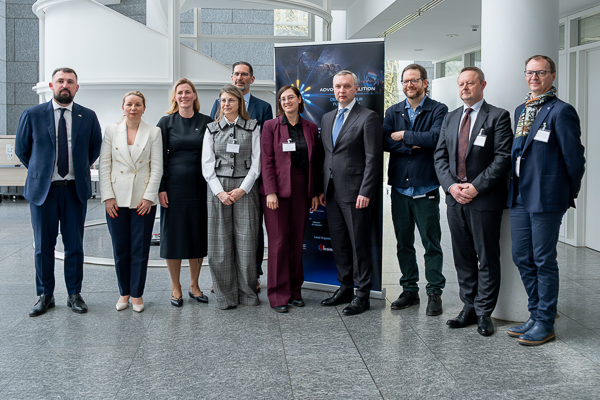
On Wednesday 15 April 2026, a conference titled "Disinformation as a threat to democracy and peace in Europe" took place at the University of Luxembourg's Kirchberg Campus, bringing together an estimated 70 participants, including policymakers, researchers and diplomats.
Organised by the Embassies of Poland and Romania in Luxembourg, together with the Representation of the European Commission in Luxembourg and the University of Luxembourg, the event formed part of the recently launched Advocacy Coalition (for Ukraine) - Defending Our Future Now initiative.
Opening the conference, moderator Philippe Schockweiler introduced the topic before Livia Rusu, Romania's Ambassador to Luxembourg, delivered her introductory remarks. The ambassador described disinformation as no longer a marginal issue but a strategic challenge. She highlighted the importance of critical thinking, transparency and accountability in creating more resilient societies to counter this challenge. She also mentioned Romania's "integrated response" based on proactive communication and media literacy support, among other things. She stressed the need for cooperation and coordinated action, noting that disinformation "knows no borders" and requires a united, systemic response.
In his remarks, Rafał Hykawy, Chargé d'Affaires at the Polish Embassy, noted that disinformation affects nearly every country and is often driven by coordinated efforts from authoritarian states. He pointed in particular to Russian narratives targeting the European Union (EU) and NATO, including campaigns portraying Ukrainian refugees negatively in Poland. Drawing on historical examples, he argued that while disinformation is not new, its scale and tools have evolved. He emphasised the role of education, as well as the importance of unity and taking effective action, in countering disinformation.
Yaroslav Melnyk, Ambassador of Ukraine to Belgium and Luxembourg, described disinformation as "one of the defining challenges" for democracy and peace in Europe today - and as a "daily reality" in Ukraine. He characterised it as a "strategic weapon" aimed at eroding public trust and exhausting societies through confusion and doubt. He warned that such tactics also serve to weaken unity and democracy, and called for a collective and coordinated response grounded in shared democratic values, including investment in critical thinking and independent journalism.
Pascal Steichen, Chair of the Governing Board of the European Cybersecurity Competence Centre, emphasised that the key distinction between information and disinformation is truth, but that this distinction is increasingly difficult in today's information environment. He highlighted the role of social media, algorithms and artificial intelligence (AI) in "pushing" certain beliefs. Describing disinformation as a technological problem, he also pointed to links between disinformation and broader cybercrime ecosystems, stressing the importance of the core cybersecurity principles of Confidentiality, Integrity and Availability (CIA). While acknowledging regulatory progress, including EU initiatives such as the Digital Services Act (DSA) and AI Act, he stressed that coordination across actors remains essential.
The introduction also featured a striking video message from Prof Marie-Hélène Jobin, Vice Rector for Partnerships and International Relations at the University of Luxembourg. Initially appearing to speak fluently in multiple languages (Romanian, Polish, Ukrainian...), she was revealed to be an AI-generated avatar, illustrating how easily realistic disinformation can be created. The real Marie-Hélène Jobin warned that such tools can undermine credibility, trust and even democracy, freedom and peace. She highlighted the responsibility of universities to equip young people with critical thinking skills, but stressed the need for alliances and dialogue. She called for significant investment in new technological solutions, noting that AI is both part of the problem and a "key part" of the solution.
The conference continued with two panel discussions.
The first panel addressed "Disinformation: facts and impact" and brought together three panellists joining online: Roman Osadchuk, Director of Threat Intelligence at LetsData; Prof Dr Alina Bârgăoanu, Dean of the Faculty of Communication and Public Relations of SNSPA and President of the Board of the European Institute of Romania; and Aleksandra Wójtowicz, digital policy analyst specialised in disinformation, Foreign Information Manipulation and Interference (FIMI) and the regulation of digital services at the Polish Institute of International Affairs (PISM).
Roman Osadchuk (representing Ukraine) focused on disinformation as a component of Russian hybrid warfare, calling for stronger enforcement and effective mechanisms, as well as greater international cooperation, to counter this threat.
Alina Bârgăoanu highlighted the complexity of modern information warfare, noting that narratives can sometimes have a greater impact than the events themselves. Referring to Romania's annulled 2024 presidential elections, she stressed that foreign and domestic interference often go "hand in hand", reinforcing each other over long periods and sometimes remaining undetected until critical moments. She called for improved tools to detect early signals of influence campaigns and warned against "cherry-picked" responses.
Aleksandra Wójtowicz addressed the role of digital platforms, particularly emerging features such as livestreaming (notably TikTok LIVE), which are difficult to moderate and can facilitate the spread of harmful content. She called for stronger enforcement of EU rules, including the DSA, as well as measures to make disinformation less profitable and harder to disseminate via digital platforms.
Following the coffee break, a second panel, focusing on "Countering disinformation", featured panellists Elīna Pinto, Head of Communications at the European Commission Representation in Luxembourg, Magdalena Wilczyńska, Director of the Division for Information Protection of Cyberspace at the National Research Institute for Cybersecurity (NASK), and Prof Mark Cole from the University of Luxembourg, who respectively spoke about strategic communication and countering FIMI, the role of NASK in response to specific disinformation campaigns, and European legal and policy responses to disinformation.
The discussions were followed by Q&A sessions with the audience, before the event concluded with a networking cocktail.