 Credit: Blitz
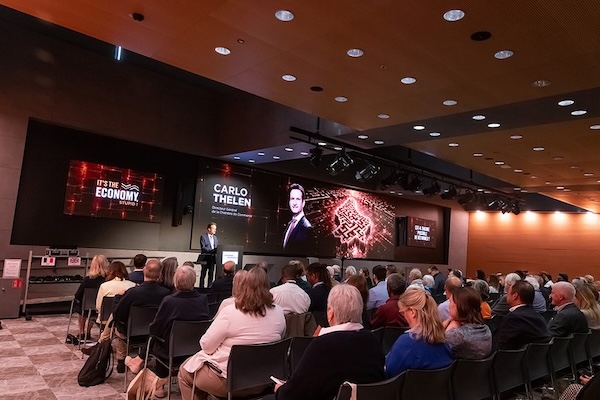
On Wednesday 16 September 2026, the Luxembourg Chamber of Commerce held the second edition of its economic forum, “It’s the economy, stupid!”, bringing together around 300 participants to discuss the obstacles to reform, the urgency of taking action and the choices facing Luxembourg and Europe.
Following a first edition devoted to the cost of inaction, this year’s forum addressed the question “Is it still possible to reform?”. According to the Chamber of Commerce, the main challenges — including productivity, competitiveness, housing, population ageing, technological transition and geopolitical change — are widely identified, but translating them into decisions remains difficult.
In his opening speech, Carlo Thelen, Director General of the Chamber of Commerce, stressed that reform did not mean calling Luxembourg’s model into question, but creating the conditions for its long-term sustainability. “To remain what we are, we must accept change. We must reform to preserve,” he said.
Gilles Finchelstein, Secretary General of the Fondation Jean-Jaurès, addressed changes in democracies and the growing difficulty of building compromises and lasting collective projects. Anne-Sophie Alsif, Chief Economist at BDO France, placed the discussion in the context of increased international competition and increasingly pressing questions of competitiveness and sovereignty.
The afternoon focused on the choices facing Luxembourg. A discussion with Minister of the Economy, SMEs and Energy Lex Delles preceded a debate involving business leaders and observers of economic life. Participants examined how to preserve prosperity without continuously increasing demand for labour, housing and infrastructure, how to finance the social model sustainably and how social dialogue could support change. Minister of Finance Gilles Roth also addressed the issues from the perspective of public finances and economic policy.
The final part of the forum turned to Europe. European Commissioner for Agriculture and Food Christophe Hansen and former European Commissioner for the Internal Market Thierry Breton discussed the European Union’s capacity to reform amid competition with the United States and China, technological change and new requirements for sovereignty.
“The issue is not reforming Europe, a luxury we can no longer afford due to lack of time. We must adapt Europe, restore its leadership and also exercise our own leverage. With a market of 450 million consumers, in particular, we have the tools to achieve this,” said Thierry Breton.
On Thursday 17 September 2026, Carlo Thelen also published a blog post, “Réformer pour préserver” (“Reform to Preserve”) , reflecting on the forum’s discussions and the obstacles to implementing economic reforms. “The problem is no longer just one of diagnosis. It is one of implementation,” he wrote. Referring to Luxembourg’s pension reform adopted in the first quarter of 2026, he described it as a step forward while maintaining that it had not settled the question of the system’s long-term sustainability.
Carlo Thelen also pointed to slower economic growth, declining investment and housing costs among the structural issues facing Luxembourg. He announced that the Chamber of Commerce would use the period leading up to 2028 to examine the country’s economic future, compare approaches and bring stakeholders together to discuss proposals.