 Bark Stripping;
Credit: National Inventory webpage
Bark Stripping;
Credit: National Inventory webpage
At the turn of the year, Chronicle.lu will present a series on ten popular and lesser-known practices passed down through generations and preserved as elements of Luxembourg’s intangible cultural heritage.
The series draws on Luxembourg’s national inventory of intangible cultural heritage, established in 2008 to document and preserve customs, crafts and community practices that contribute to the country’s cultural identity.
The list is managed by Luxembourg's Ministry of Culture with advice from the Cultural Heritage Commission (COPAC) and aligns with the UNESCO Convention for the Safeguarding of the Intangible Cultural Heritage. It includes five categories: oral traditions and expressions; performing arts; social practices, rituals and festive events; knowledge and practices concerning nature and the universe; and traditional craftsmanship.
Marking the International Day of Intangible Cultural Heritage on 17 November 2025, the Culture Ministry announced five new additions to the list, now comprising a total of 21 elements. For more on this, see https://chronicle.lu/category/culture/57416-luxembourg-adds-5-traditions-to-national-intangible-cultural-heritage-inventory
“Louschläissen”
The next activity explored in this series is a practice called “louschläissen” (bark stripping), a long-standing tradition of removing the “lou” (tanbark) from young oak trees.
The practice of transforming bark into a leather-tanning material for use in local tanneries was added to the national inventory in October 2025 under the category “knowledge and practices concerning nature and the universe”.
Around 35% of Luxembourg’s surface area is covered by forest, home to a wide range of tree and plant species, including oak, maple, ash and, most commonly, beech. Local landworkers have long developed knowledge and inherited forestry practices that use not only living trees but also deadwood, old trees and their bark, valued for its tannic acids.
The “louschläissen” and related “louheck” (oak coppice) practices were widespread from the 1600s onwards, representing a unique form of forest management that went beyond conventional methods. The practice involves a series of preparatory steps before the main process begins.
In winter, the oak coppice woods are prepared for “louschläissen” through a clearing step called “raumen”. All trees and shrubs other than the oaks are cut and processed into firewood, opening up the area around the oaks.
Later, at the beginning of summer, typically around May or June, the actual process of bark stripping begins. Workers first cut off the lower branches of the standing oak using a sickle or “kromm” (a curved axe). The bark is then carefully sliced around the trunk, no higher than an adult’s height, and split lengthwise two or three times using a tool called the “rësser”.
The process continues with the peeling of the bark using a specialised tool known as the “louläffel”, which is used to “schläissen” (strip) the bark from the trunk. After this, the tree is cut at about one metre above the ground, with the trunk remaining attached to the stump, allowing more efficient bark stripping. The upper branches are then removed, the trunk is stabilised again and the remaining bark is taken off in sections of about two metres.
To finish, the lower part of the trunk is felled, completing the step known as “op de Stack setzen” (bringing the tree fully to the ground), and the wood is cut into firewood.
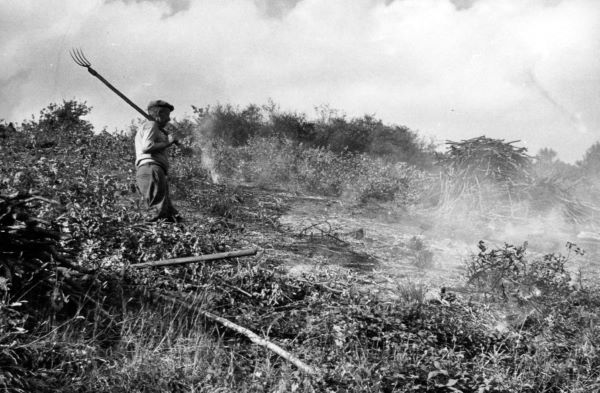
The post-harvest stage begins once the bark and the wood, used for heating, have been removed. The remaining branches and foliage were traditionally “sang” (burned), and the resulting ash was spread across the ground as fertiliser.
The collected oak bark was then sold to tanneries for leather production. After being ground into small flakes or powder and soaked in water to release the tannins, the bark was used to make the leather stable, flexible and long-lasting.
During the next two years, the cleared land is cultivated with grains such as rye, “wëllkar” (buckwheat) or oats, until the oak trees begin to sprout again. Once the new trunks reach a suitable size, typically after fifteen to 20 years, the cycle of “louschläissen” can begin again.
The largest and most important leather-producing centre in Luxembourg was Wiltz, which hosted more than 20 tanneries in the 1800s. Other towns, including Ettelbruck, Diekirch and the Clervaux region, also had individual tanneries, although on a much smaller scale.
Demand for oak bark declined in the nineteenth century as quicker and cheaper tanning methods emerged. In Wiltz, this shift led to the closure of the last major tanneries in the mid-20th century, including Lambert in 1953 and IDÉAL in 1961.
As the industry disappeared, the need for tanbark also faded, and many “louhhecken” (oak-coppice woods) were abandoned or replaced by other forms of forestry. Nevertheless, the practice continues today for its cultural, ecological and historical significance.
Beyond Luxembourg, similar bark-stripping and oak-coppice practices were once widespread across Central Europe, particularly in Germany and France, as well as in parts of Eastern Europe. Today, these countries, like Luxembourg, maintain the practice not for economic reasons but for its cultural and ecological value.
EO