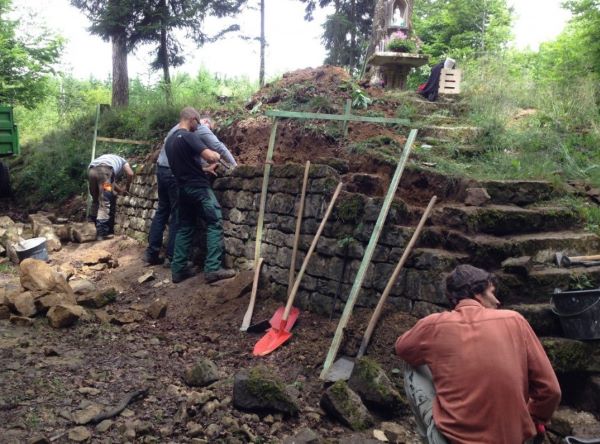
 Credit: National Inventory webpage
At the turn of the year, Chronicle.lu will present a series on ten popular and lesser-known practices passed down through generations and preserved as elements of Luxembourg’s intangible cultural heritage.
The series draws on Luxembourg’s national inventory of intangible cultural heritage, established in 2008 to document and preserve customs, crafts and community practices that contribute to the country’s cultural identity.
The list is managed by Luxembourg's Ministry of Culture with advice from the Cultural Heritage Commission (COPAC) and aligns with the UNESCO Convention for the Safeguarding of the Intangible Cultural Heritage. It includes five categories: oral traditions and expressions; performing arts; social practices, rituals and festive events; knowledge and practices concerning nature and the universe; and traditional craftsmanship.
Marking the International Day of Intangible Cultural Heritage on 17 November 2025, the Culture Ministry announced five new additions to the list, now comprising a total of 21 elements. For more on this, see https://chronicle.lu/category/culture/57416-luxembourg-adds-5-traditions-to-national-intangible-cultural-heritage-inventory
“D’Konscht vum Dréchemauerbauen”
The ancient technique of “d’Konscht vum Dréchemauerbauen” (the art of dry stone construction) was added to the national inventory in November 2018 under the category “traditional craftsmanship”, as well as to the UNESCO Representative List of the Intangible Cultural Heritage of Humanity in December 2024.
This practice involves assembling different types of stones with precise and meticulous craftsmanship to create a solid, stable, self-supporting structure packed tightly together. Without mortar or concrete used as binding agents, its stability depends on the builder’s understanding of geometry and gravity, along with skills honed over years of working with locally gathered raw materials and a few simple tools, namely a hammer, a steel bar, a pick, a shovel and a chalk line.
The history of dry-stone wall construction dates back to the Neolithic period, when the first agricultural settlements appeared. As fields were ploughed, stones that hindered cultivation were moved to the edges. Over time, these piles grew too large and were arranged more neatly, eventually forming boundary walls. This construction model was used in many types of structures, including housing, shelters, fortifications, tombs, terraces and communal or religious buildings. As the techniques developed, some of the craftsmanship came to be seen as “pieces of art”.
As centuries passed, the technique continued to evolve. However, it experienced a significant decline in the 20th century, when new construction methods and materials, including brick, concrete and mortar, along with the mechanisation of agriculture, began to spread. As a result, many old walls fell into disrepair and fewer people were able to inherit the traditional skills.
To address this decline, a European (Interreg) territorial cooperation programme launched a project in the Greater Region in 2016 to restore and promote the knowledge and skills of these constructions through a series of targeted actions.
Even though Luxembourg is not among the countries which are widely known for dry stone construction traditions, such as Ireland, Scotland or England, it still holds an important local practice that has survived into modern times.
Today, the qualities and benefits of this old stone stacking technique make the practice particularly relevant, both for heritage conservation and for ecological, landscape and sustainable-development reasons. In 2023, Luxembourg’s Culture Ministry recalled that dry stone construction matches several aspects of the 2030 Agenda for Sustainable Development, including industry, innovation and sustainable infrastructure, sustainable cities and communities, life on land and its direct contribution to protecting biodiversity.
Across Luxembourg, dry stone structures that still exist today can be found in vineyard walls along the Moselle, on dry stone walking trails in the Müllerthal, in slope reinforcements in the Oesling, in drainage and irrigation systems in the valleys, in stabilisations of riverbanks, private properties and other places throughout the country.
Several places in the Grand Duchy help to keep the practice alive by offering workshops and guided walks, such as the Mëllerdall Nature and Geopark in the Müllerthal region and the Slate Museum in Haut-Martelange. Their efforts are supported by a small number of active organisations, including nature parks, museums, specialised construction companies and partners of the cross-border Interreg project.
EO