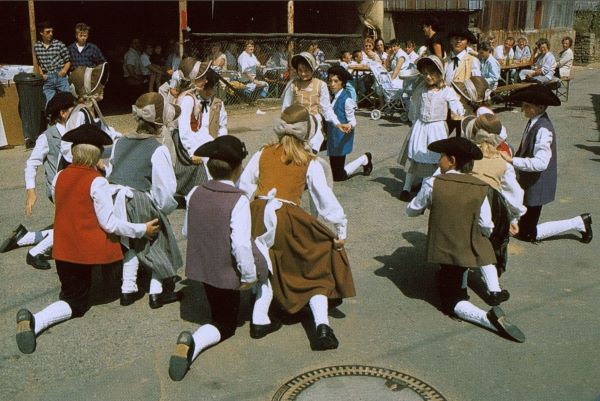
 Credit: National Inventory webpage
At the turn of the year, Chronicle.lu will present a series on ten popular and lesser-known practices passed down through generations and preserved as elements of Luxembourg’s intangible cultural heritage.
The series draws on Luxembourg’s national inventory of intangible cultural heritage, established in 2008 to document and preserve customs, crafts and community practices that contribute to the country’s cultural identity.
The list is managed by Luxembourg's Ministry of Culture with advice from the Cultural Heritage Commission (COPAC) and aligns with the UNESCO Convention for the Safeguarding of the Intangible Cultural Heritage. It includes five categories: oral traditions and expressions; performing arts; social practices, rituals and festive events; knowledge and practices concerning nature and the universe; and traditional craftsmanship.
Marking the International Day of Intangible Cultural Heritage on 17 November 2025, the Culture Ministry announced five new additions to the list, now comprising a total of 21 elements. For more on this, see https://chronicle.lu/category/culture/57416-luxembourg-adds-5-traditions-to-national-intangible-cultural-heritage-inventory.
Traditional Luxembourg Folkdances
Added to the national inventory in October 2020 under the category “performing arts”, traditional Luxembourg folk dances (“Lëtzebuerger Volleksdänz”) are actively researched, practised, performed and passed on to new generations.
The history of this custom in Luxembourg stretches back many centuries, with records showing that people used to dance at community gatherings, seasonal celebrations and funfairs, which are also listed among the influential local traditions.
With World War I, the tradition of folk dancing was partly abandoned, a trend that continued with the modernisation of the 20th century, when this custom, like many others, started fading away from everyday life. This decline encouraged historians, musicians and cultural enthusiasts to take a renewed interest in researching these practices.
Research carried out by ethnologists and musicologists made it possible to trace these ancient traditions and to reconstruct the melodies and dance steps.
Around the 1930s, members of the “Jugendherbergsbewegung” (youth hostel movement) became aware that old traditional dances and songs were being lost. They began conducting research by interviewing people who had experienced these practices in their youth. After World War II, folklore clubs were founded to implement and preserve this knowledge.
The classic repertoire includes around 30 dances that are all performed in couples. In international comparison, Luxembourg’s folk dances stand out for their large variety of basic steps, figures and melodies, as well as for the frequent change of partners, according to the national inventory.
Arranged for the stage by specialists, several dances have become popular among amateurs, who perform them on stage. These include “Chiberli”, “Siwesprong”, “Pik-Polka”, “Minnewee”, “Karschnatz”, “Konterdanz”, “Eifeler Maklott”, “Maclote d’Habiémont”, “Härendanz”, “Sonndesdanz”, “Schottësch Näip”, “Troïka”, “Sabotière”, “Ardennes Dance” and “Stréinen Hunn”.
Beyond the dance itself, performances include two other important elements: live music and traditional costume. The various attires are reproductions based on fashion from the late eighteenth and early nineteenth centuries and are grounded in research carried out by the and the Archives. The dance shoes are stylistically matched to the costumes, while being adapted to modern safety standards. Some dances also involve the use of accessories such as ribbons, lanterns and scarves.
Both women’s and men’s costumes are made only from period-accurate reproduction fabrics. Traditional men's clothing is based on rural festive attire and typically consists of a white shirt paired with knee-length trousers or long wool trousers in muted colours. A blue smock or jacket is often worn on top, sometimes with simple decorative details for performances. The outfit is completed with long socks or stockings, sturdy leather shoes and, in some cases, a traditional hat or cap, depending on the group and region.
Women’s costumes consist of three main parts: a skirt, a white blouse with a bodice (casaquin) and an apron. The white linen blouse is fastened at the neck and trimmed with fine crocheted lace, paired with a long printed cotton skirt and headwear. Variations include a bodice with short puffed sleeves in a bright, solid colour, different types of headwear and a range of decorative motifs such as flowers or stripes.
Musical accompaniment features Luxembourgish folk songs played on the fiddle, drumsee, diatonic accordion, wind instruments, guitar and percussion.
Nowadays, folk dance is a central feature of major popular festivals such as “Eimäischen” held annually on Easter Monday in Luxembourg, as well as “Nationalfeierdag” (Luxembourg’s National Day), “Baurekirmes” (farmers’ festival) and wine festivals.
Numerous performances also take place at cultural events and official occasions, both nationally and internationally, where Luxembourg is represented. Folk dance groups are considered to serve as ambassadors of Luxembourg’s culture, for example during a performance at UNESCO in Paris in 2007, the Folkloriada festival in Mexico in 2016 and the sixth CIOFF World Folkloriada festival in 2021.
Among the most popular Luxembourgish folk dance groups are Uucht-La Veillée in the Luxembourg City area, Vallée des Sept Châteaux in Mersch and La Ronde in Bettembourg, all of which rehearse regularly and perform at national celebrations, cultural events and international festivals.
EO