 Credit: National Inventory webpage
At the turn of the year, Chronicle.lu will present a series on ten popular and lesser-known practices passed down through generations and preserved as elements of Luxembourg’s intangible cultural heritage.
The series draws on Luxembourg’s national inventory of intangible cultural heritage, established in 2008 to document and preserve customs, crafts and community practices that contribute to the country’s cultural identity.
The list is managed by Luxembourg's Ministry of Culture with advice from the Cultural Heritage Commission (COPAC) and aligns with the UNESCO Convention for the Safeguarding of the Intangible Cultural Heritage. It includes five categories: oral traditions and expressions; performing arts; social practices, rituals and festive events; knowledge and practices concerning nature and the universe; and traditional craftsmanship.
Marking the International Day of Intangible Cultural Heritage on 17 November 2025, the Culture Ministry announced five new additions to the list, now comprising a total of 21 elements. For more on this, see https://chronicle.lu/category/culture/57416-luxembourg-adds-5-traditions-to-national-intangible-cultural-heritage-inventory.
“Léiffrawëschdag”
The well-known Assumption Day holiday, celebrated annually on 15 August, holds a deeper meaning through a long-observed tradition of blessing herbs and flowers, known in Luxembourgish as “Léiffrawëschdag”.
Rooted in Christian tradition and linked to the belief in the Assumption of the Virgin Mary, the timing of the custom also coincides with traditional harvest periods that predate Christianity. It reflects gratitude for agricultural abundance through long-standing rural traditions.
Added to the national inventory in October 2020 under the category “social practices, rituals and festive events”, this practice consists of gathering a bundle of herbs (known as “wësch”, blessing it under the protection of the “léif Fra” (Dear Lady) and taking it home in the hope of a plentiful harvest. The custom has been observed for centuries, particularly in rural areas.
The ritual takes place in various settings, including private and public spaces, either individually or in groups. Before the holy mass, participants collect up to 35 different herbs, grains and vegetables from fields, gardens, forests and meadows and tie them into a “krautwësch” (herb bundle). Knowledge of the composition and number of plants is passed down through generations and varies between places and families, although certain ingredients recur. Many of the selected herbs traditionally served as home remedies, while the number of plants is said to hold symbolic importance.
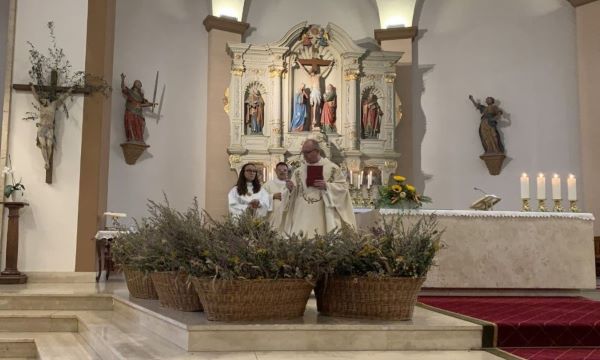
Later, during the solemn high mass or the evening mass, people bring their herb bundles to the church and place them at the foot of the altar to receive a blessing. In some cases, the service takes place outdoors, although a priest is always present and performs the blessing using a dedicated prayer and holy water.
Following the mass, participants take their blessed bundles home or, in some cases, individuals or associations prepare bundles for distribution, allowing those without their own to receive one, often in exchange for a voluntary donation to charity. The celebration often ends with a social gathering.
While the tradition was once observed in villages across the Moselle region, it fell out of practice for a period before being revived in 1985 within the village community of Greiveldange. Since then, the non-profit organisation Greiweldenger Leit has continued to preserve the custom through its annual wine festival, which gathers thousands of visitors and local associations.
According to the national inventory, this custom raises awareness of nature and the environment and reflects historical changes in people’s beliefs and ways of life, offering participants a sense of identity and continuity beyond religious practice.
To this day, some people hang the bundle in their homes or surrounding areas, believing it brings blessings and helps ward off misfortune.
EO