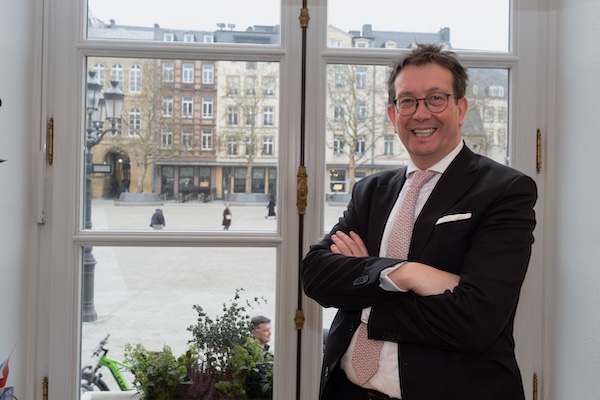
 Maurice Bauer, MP, Budget Rapporteur;
Credit: Ali Sahib, Chronicle.lu
Maurice Bauer, MP, Budget Rapporteur;
Credit: Ali Sahib, Chronicle.lu
On Monday 19 January 2026, Luxembourg Deputy (Member of Parliament, CSV party) Maurice Bauer sat down with Chronicle.lu to discuss the 2026 state budget for which he was appointed Rapporteur.
The 2026 budget was presented to parliament in December by Luxembourg's Minister of Finance, Gilles Roth, showing projected revenues of €31.1 billion, and expenditure of €32.6 billion, i.e. a deficit of almost €1.5 billion.
Maurice Bauer explained that he was appointed Rapporteur last July, a position he described as "an enormous honour" and which he held until the vote on the budget law in December. He confirmed "Unfortunately, you get the official figures only beginning of October. So between July and October, you do not have any document where you can work really on it". He explained that he was then able to liaise with the social actors (trade unions) and economic actors (company federations and employer representatives): in this context, he explained "in order to get a picture of the financial situation, or of the situation of the country, and then to add this to the financial aspects, which you get in October, in order to do out of this a whole picture, an overall picture of the situation of the country".
Maurice Bauer also spoke about the Rapporteur having the "freedom to choose one specific aspect, which he goes more into detail... for me, I took together with my team of the CSV parliamentary group, we decided that we would like to go more in detail on the social aspect of fighting against poverty". He clarified "my role is officially concluded, as with the vote of the budget"; however, he put forward a total of sixteen recommendations. "And now I try of course, to get these recommendations adopted".
Chronicle.lu: How can you justify the budget deficit?
Maurice Bauer: Because this budget is a voluntary budget, which is anti-cyclic, where we try to invest a lot of money in order to support the Luxembourgish economy to diversify, to bring new companies to Luxembourg, to stay attractive. We never have to forget that we are in competition with all our European partners and even broader in the overall the world, our competitors. And we have to stay in a driving seat concerning innovation, concerning new technologies, concerning attractiveness of Luxembourg.
And this is a political choice. Either we want to do this or we don't want to do this. We can, without too much problems, bring this deficit to zero if we don't invest anymore in companies, in the Luxembourgish economy, in the financial sector, in social network, in the ecological transition.
But if we do so, Luxembourg will not stay as attractive as it is today. So it's a deliberate choice of the government and this coalition that we want to invest a lot of money in order to get an added value and a return on investment from new companies coming to Luxembourg, from companies expanding their activities in Luxembourg, from companies discovering Luxembourg. Because this creates working places, this creates new incomes in terms of tax revenues.
And I think that's the reason behind this choice to accept that we have this negative balance, knowing that our overall financial situation is still very positive. We are absolutely complying with all European requirements. We have a state deficit of the budget of the state which is 27%, which is absolutely okay given the European requirements.
So from our point of view I think it's a positive message we get to give to the outside economy and to the European economy that Luxembourg is still believing in its diversity, in its growth, and I think that's helpful.
Chronicle.lu: One of the things that has been announced recently has been the expansion of its network of embassies, consulates and trade offices internationally, which will hopefully then result in more FDI, more foreign direct investment within Luxembourg to help those. Maybe we can look at a couple of other points as well. One is the issue of social welfare, and pensions in particular. Recently there was agreement between the government and the social partners in relation to pension reform, but it seems that the unions ... stopped the government implementing significant changes to the pension eligibility, etc. Can you comment on that?
Maurice Bauer: I have a much more positive view on this because I must say that if we step back three years ago when this government entered into coalition in office there was nobody except the coalition and the employers' representatives who told us that there was a real issue on pensions. All the other parties, all the other labour organisations or social partners have clearly stated there is no issue with the Luxembourgish pension system. Today, two years later, we have found a beginning of an agreement which is not very powerful, but at least it's a significant message to everybody that Luxembourg is able to find an agreement if it needs to find an agreement. That's the first positive aspect. The second aspect is now there is a national consensus that we have an issue on the pension system over the next years so that there is an obligation to find new solutions over the next years.
Chronicle.lu: Can you tell us from the point of view of the budget what policies and initiatives are in the budget to address the issue of affordable housing?
Maurice Bauer: Yes, so I think housing has been clearly identified as the most important issue for Luxembourg, also for its competition towards our neighbouring countries because until now there was no issue about this, and in the meantime people are hesitating to come to Luxembourg because of the housing crisis. That's a real issue which we have to address. And therefore the current coalition has over the last two years yet taken a lot of measures in order to make housing more affordable for a lot of people, and in the current budget we have also announced that there will be €2 billion for instance invested in affordable housing over the next four years which is a significant amount.
We have decided that we will increase the help for those who have not the possibility to pay everything so the subsidising of rents have been increased. There have been a lot of clear messages which have been given to continue the situation. The government has decided to foresee in the budget also a certain amount for construction. Here we need a collaboration between the public sector and the private sector if you want to get a solution over the next years.
Chronicle.lu: Luxembourg is a very wealthy nation but there is a continuing and deepening issue of poverty. Can you tell us how the budget going forward is going to help to combat poverty in Luxembourg?
Maurice Bauer: I think Luxembourg has always stated that this issue is a main issue in the budget, and if you see in the budget this year there is still 46% of all the expenditures which are linked to social welfare. That's something which concerns social housing but it also helps people which are living under the risk of poverty; I think here again the government has clearly stated for instance the institution which pays the family allocations gets €1.6 billion which was much more than they had before. We have enormously also tried to free a lot of people from their fiscal payments.
Today a person who is mono-parental does not pay taxes until the amount of €54,000 for instance, which is something where the mono-parental situation is much more subsidised... until now we had the situation if you needed some subsidies you had to go to see either the commune [municipality] or the national institutions... You had to fill out forms and forms for every administration. There the government has clearly also in this budget foreseen money in order to get rid of this [bureaucracy].
On the other hand, the government has also ... started paying automatically to those who where we are sure that they can benefit from these and where they are eligible to these helps. People beforehand had to proactively go and ask for them. I also proposed to extend this automatisation to the subsidies for housing because we know that there are 75% of the people who are eligible to get this help who don't get it finally because either they don't know where that they are eligible or they are not courageous enough and show that they are they are poor, so it's always the question also of stigmatisation.
Then of course [there was] the recent announcements in December ... of the new National Poverty Plan, of course also something exceptionally important because first of all there are more than 107 measures which have been announced, but mainly what I feel also is very much appreciated was that this plan was elaborated from the government together with the actors in the field - that's the first time that there is national action plan against poverty in Luxembourg, the first time that something like this is elaborated, and it was done over the last two years together with hundreds of associations which were consulted. Most of those budgetary impacts will only start having an impact in 2027, but it's an enormous step towards fighting against poverty ... and which hopefully will help us to bring down the level of poverty in Luxembourg which currently is at 18.1% after having been 18.8% in 2023.
Chronicle.lu: The last point that I would like to talk about now is the issue of defence in relation to the budget: the defence budgets across the EU, and of course in Luxembourg as well, have increased - where is that spending expected to go?
Maurice Bauer: I think before last year Luxembourg had engagement to go up to 2% of the national revenue [GDP] and last year Luxembourg accepted to go up to 5% until 2035. This 5% is composed of two different elements: first a real military aspect concerning 3.5% which only concerns amounts which are directly linked to the military costs. The remaining 1.5% is more linked to infrastructure projects which are in relation with military, but which can be the renovation of bridges, for instance airport improvement [linked infrastructure projects].
I think the government will, after having been [in] consultation rounds with NATO, find out what projects can be financed. There's also this dual use projects which are chosen where the Luxembourgish economy has also some return on investment,... as an example the satellite technology where Luxembourg has created a lot of workplaces ... increasing the attractiveness of Luxembourg for this subject.