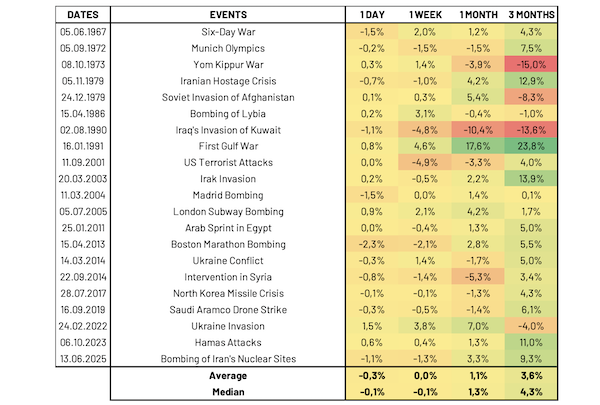
 The historical impact of geopolitical events on S&P500;
Credit: Indosuez Wealth Management
The historical impact of geopolitical events on S&P500;
Credit: Indosuez Wealth Management
On Monday 2 March 2026, Indosuez Wealth Management, the wealth management subsidiary of the Crédit Agricole Group, published an investment note assessing the escalation of tensions between the United States, Israel and Iran and the potential impact on global markets.
In its latest CIO Perspectives, the firm outlined three possible scenarios for the conflict and highlighted oil as the main transmission channel of economic risk.
According to Indosuez, markets had already begun pricing in the risk of further escalation as negotiations between the United States and Iran appeared to stall. While hostilities intensified over the weekend, the firm described oil as “the primary channel of economic transmission”, noting that energy prices remain the key factor for assessing potential economic spillovers.
The reaction in financial markets has so far been relatively contained. The S&P 500 declined by around 1%, while the Stoxx Europe 600 fell by approximately 1.5%. At the same time, energy and defence-related stocks advanced, gold rose by 2% and Brent crude approached $78 per barrel. The US ten-year Treasury yield stood just below 4%, after falling by roughly 30 basis points since early February.
Indosuez highlighted the strategic importance of the Strait of Hormuz, through which nearly 20% of global oil and gas production transits. Although closure of the strait is not considered the base case, the firm warned that such a development could push oil prices above $100 per barrel, significantly increasing inflationary pressures. However, it stated that it remains “premature to buy the dip”, maintaining a diversified asset allocation while closely monitoring developments.
The firm identified three possible scenarios for the conflict:
Scenario 1: No escalation, status quo (base case)
In this scenario, Iran weathers the crisis and fighting subsides within weeks, in line with predictive markets expecting a ceasefire by the end of April. The Strait of Hormuz experiences traffic disruptions but remains open, and oil prices return to $60-70 per barrel as the geopolitical risk premium stabilises. Based on current information, Indosuez considers this the most likely outcome.
Scenario 2: Escalation and recession risks
Under this scenario, the conflict intensifies and Iran expands hostilities across the Middle East, leading to a closure of the Strait of Hormuz and sustained disruptions to regional oil supply. Oil prices rise beyond the existing geopolitical risk premium by a further 20%, approaching $100 per barrel. Indosuez describes this as a potential “stagflationary shock” for the global economy, with higher energy prices driving inflation, weighing on trade balances and increasing downside risks to growth.
Scenario 3: De-escalation with medium-term regime change
In this case, a new Iranian government emerges and significantly reduces retaliation under international pressure, resuming negotiations with the international community. This would restore a more stable regional balance, potentially leading to a sharp decline in oil prices towards $50 per barrel amid excess capacity, supporting global growth.
The firm noted that the recent escalation has increased the probability of a “stagflationary shock” under Scenario 2. However, it stressed that global oil intensity is significantly lower than in previous decades and that financial transmission channels appear less vulnerable, which should help mitigate the impact.
Despite elevated uncertainty, Indosuez said it maintains its current asset allocation, remains invested in equities and continues to emphasise diversification. The firm retains exposure to emerging markets as well as recent investments in commodities and defence sectors. It also maintains its view that the US dollar has further downside potential, while gold continues to serve as a hedge against geopolitical and inflation risks.