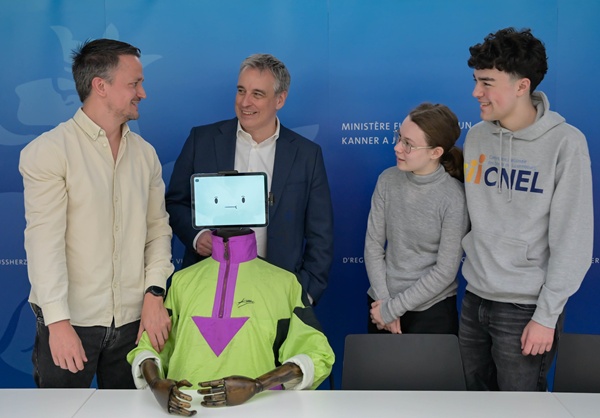
 (L-R) Jeff Kaufmann, BEE SECURE; Claude Meisch, Luxembourg's Minister of Education, Children & Youth; René, a robotic doll; Lorena Salvaggio, CNEL; Alessio Paciotti, CNEL;
Credit: MENEJ
(L-R) Jeff Kaufmann, BEE SECURE; Claude Meisch, Luxembourg's Minister of Education, Children & Youth; René, a robotic doll; Lorena Salvaggio, CNEL; Alessio Paciotti, CNEL;
Credit: MENEJ
On Friday 16 April 2026, Luxembourg's Ministry of Education, Children and Youth presented a new campaign aimed at raising awareness among young people about the limits of artificial intelligence (AI) and chatbots.
According to the ministry, young people today are no longer just confronted with the internet or social media: they also interact with AI capable of simulating attention, responding to them and providing support, all while memorising personal information. Increasingly natural and fluid, interactions with such chatbots can become problematic when they replace human relationships or alter social behaviours.
In response to this trend, the ministry is launching the "AI ≠ Human" campaign. Presented at a press conference by Claude Meisch, Luxembourg's Minister of Education, Children and Youth, the campaign aims to encourage a more critical use of chatbots and to reiterate a crucial message: AI is a useful tool, but it does not replace human interaction.
“Behind the use of chatbots, there is often a deeper reality: loneliness. AI can create the illusion of presence, but it will never replace a human being. We must prevent young people seeking support from getting lost in this illusion, help them distinguish between real and human interactions, and ensure they find the right person to talk to at the right time,” stated Minister Meisch.
The campaign is based on the results of the BEE SECURE Radar 2026, which confirmed the entrenchment of chatbots in young people’s digital habits. Nearly all young people reported having used them (96% of 12- to 16-year-olds and 97% of 17- to 30-year-olds) and about a quarter use them daily. While this use is often practical and helpful (for searching for information, rephrasing ideas, etc.), the conversational tone adopted by chatbots can also create the illusion of a relationship that should not be confused with genuine human interaction, the ministry warned.
According to the BEE SECURE Radar 2026, 17% of young people see AI as a friend, 20% use it to feel less alone and 5% believe it can replace time spent with other people. Half of young people said they use it occasionally to get personal advice, while about a quarter discuss personal topics they would not share with others.
These findings, also observed in several recent international studies, underscore the need to raise awareness among young people and those around them about the more critical and thoughtful use of chatbots, the ministry said.
This need also emerged during discussions the ministry held with the National Students' Conference in the context of exchanges surrounding "KI Kompass", the strategic framework for the responsible use of AI in schools. Students highlighted the feeling of loneliness experienced by many young people, which leads them to turn to AI, often at the expense of genuine friendships. They also expressed the need for a campaign to further raise awareness among young people about this issue.
Like KI Kompass, the campaign puts humans at the centre and warns against the thoughtless use of artificial intelligence, while emphasising that AI can lead to not only cognitive dependence but also emotional dependence when it replaces human interaction. The goal is therefore to raise students' awareness of the conscious use of AI and to reinforce the importance of authentic human relationships and independent thinking.
The "AI ≠ Human campaign" reminds the public that a chatbot can be useful in many contexts, but that it is limited to analysing and generating statistically probable responses. It does not replace human empathy, the support of a loved one or guidance from a professional. Human listening includes emotion, unspoken elements, context and responsibility. The ministry also recalled that young people can turn to their peers, their family or any trusted person, but also to trained professionals, such as the psycho-social-educational services available in secondary schools.
The campaign's messages are conveyed through five slogans: "AI can't hug you back"; "AI can't think for you"; "AI remembers everything"; "Talk to your kids before AI does"; and "AI can listen, but it can't feel".
The campaign revolves around five key issues:
- Social isolation: Chatbots can simulate listening, availability and attentiveness. This constant presence may seem reassuring, but it does not replace a real human relationship
- Substitution for human relationships: When chatbots are perceived as friends, reassuring presences or preferred interlocutors, the line between technical simulation and human interaction becomes blurred
- Decline in real dialogue: The fact that certain sensitive questions are more readily entrusted to a tool than to a trusted person may reveal a difficulty in finding a space for speaking or listening in real life
- Personal data and privacy: Information shared with a chatbot, especially when sensitive or personal, does not necessarily remain confidential or protected
- Cognitive outsourcing: Systematically relying on AI to formulate, decide or reflect can weaken independent thought and critical thinking
The campaign targets young people aged twelve to 30 and their families. It is the result of a collaboration between the Education Ministry, the BEE SECURE service, a government initiative coordinated by the National Youth Service (SNJ), the Psychosocial and Scholastic Assistance Centre (CePAS) and the National Students' Conference of Luxembourg (CNEL).
At the heart of the campaign, the robotic doll "René" serves as its visual thread, helping to make its message accessible and interactive. René is present in digital content as well as during on-the-ground activities and visits to various secondary schools, where he interacts with young people. He provides answers to frequently asked questions, guides young people and directs them to appropriate support services or information.
The campaign will run from April to June 2026 and is being rolled out across several channels: the website nothuman.lu, which centralises key messages, visual content, a video and the schedule of various activities; a presence on the social media platforms; activities conducted by BEE SECURE in secondary schools, in collaboration with CePAS, and in public spaces, allowing young people to interact with René; posters in public spaces; and the use of influencers to amplify the campaign's messages.
Across these channels, the campaign will illustrate its central message: artificial intelligence, designed and programmed by humans, remains a tool - not a person.