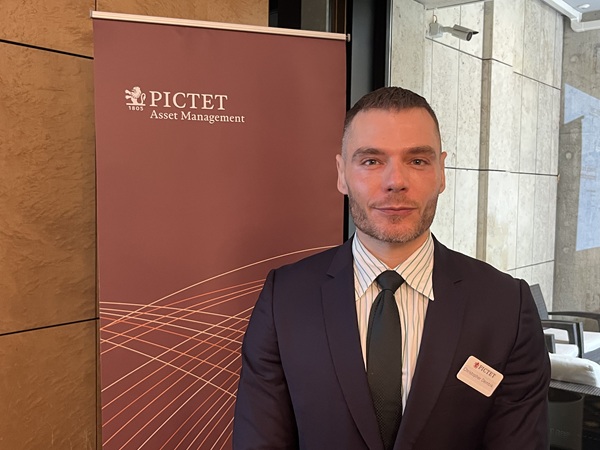
 Christopher Dembik, Pictet Asset Management;
Credit: Chronicle.lu
Christopher Dembik, Pictet Asset Management;
Credit: Chronicle.lu
On Tuesday 3 February 2026, Pictet Asset Management hosted its Investment Outlook 2026 briefing at the Hotel Le Royal in Luxembourg-Ville.
The briefing, attended by around 100 representatives of Luxembourg’s finance and investment industry, was provided by Christopher Dembik, Investment Strategy Advisor at Pictet Asset Management.
The briefing was based around the central themes of de-dollarization and geographical rotation and began with a brief review of developments and trends from 2025, including the performance of speculative funds, exchange-traded funds (ETF) and money markets, the impact of American monetary policy and the performance and importance of precious metals.
On Europe, Christopher Dembik said that it was already noticeable that the potential for growth in the US looks greater than that in Europe despite end-of-year analysis which suggested that growth in the Eurozone would be of more significance. He noted that despite the expectation of inflationary pressures, estimates show that American inflation will stay between 2.5% and 3% for a large part of 2026. To which he underlined: “These are not levels of inflation that are problematic”.
Christopher Dembik then talked of the influence of the change of the US Federal Reserve Governor and the slowdown in productivity of the Eurozone compared to the US, noting that despite slowdowns in both, the US had rebounded quicker than Europe. He highlighted that between 2019 and 2024 the productivity accumulated in the United States was around 10% but only 2.4% in the Eurozone, with the added issue of large disparities between the Eurozone countries. Here he emphasised the “need to be extremely selective” on Europe’s vision and that it was necessary to take political risks into account.
Christopher Dembik also noted the decoupling of global trade, which he highlighted was not only linked to the policies of US President Donald Trump but also to other strategies. In terms of Gross Domestic Product (GDP) over time, he stated that global wealth is currently more concentrated in the Asian zone than in the rest of the world.
This moved the presentation on to the subject of de-dollarization and the moves by both Russia and China to reduce the use of the US dollar in reserves, trade invoicing and settlement, cross-border finance and domestic transactions. Christopher Dembik stated that it was important to understand that this was not purely a political strategy.
On the impact of Artificial intelligence (AI), Christopher Dembik noted the dominance of the US in the development of LLM’s (Large Language Models) but highlighted the Chinese hegemony in the field of robotics, a trend he linked to the Trump administration’s plans for a “reboot in robotics”, given the close correlation between the two technologies.
This led to the subject of energy consumption and the transition to cleaner energy sources in a world where technological developments demand ever more energy and the legal shift to prohibit subsidies in the sector from foreign entities.
Other subjects discussed included the impact and potential of emerging markets such as Brazil, which has seen a two-year record in terms of foreign investment flows on its debt and shares, and how public debt in percentage of GDP of emerging countries is 60% in comparison to 120% for the G7 countries (Canada, France, Germany, Italy, Japan, UK and US).
Lastly, Christopher Dembik noted the uncertainty of American policy and the weak evolution of the US Dollar. He said: “You have a lot of studies that have been done in the last few years that show you a real impact of the dollar on the decline of American exports. […] Today, according to the calculations, the dollar-index is overvalued by about 10%. It is clear that it can still continue to drop.”
There then followed a Q&A session with questions fielded from the audience members.
The event concluded with a networking lunch with food and refreshments supplied by the hosts.