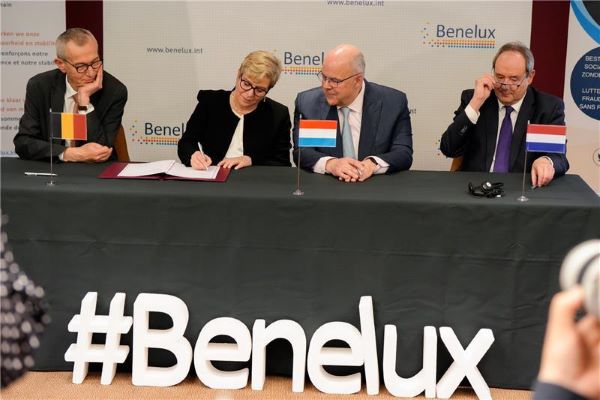
 (L-R) Frank Vandenbroucke, Belgian Minister of Social Affairs and Public Health; Martine Deprez, Luxembourg’s minister of Health and Social Security; Marc Spautz, Luxembourg’s Minister of Labour; Hans Vijlbrief, Minister of the Netherlands;
Credit: Ministry of Health and Social Security
(L-R) Frank Vandenbroucke, Belgian Minister of Social Affairs and Public Health; Martine Deprez, Luxembourg’s minister of Health and Social Security; Marc Spautz, Luxembourg’s Minister of Labour; Hans Vijlbrief, Minister of the Netherlands;
Credit: Ministry of Health and Social Security
On Monday 9 March 2026, Belgium, the Netherlands and Luxembourg signed a new Benelux treaty aimed at tackling cross-border social fraud and social dumping more effectively.
According to Luxembourg's Ministry of Health and Social Security and the Ministry of Labour, this new treaty facilitates joint inspections, accelerates the exchange of social security data and enables closer cooperation in recovering benefits and contributions that were wrongly paid. It also aims to strengthen worker protection through inspections focusing on workplace safety, hygiene and decent working conditions.
The treaty was signed by four ministers: Hans Vijlbrief, Minister of Social Affairs and Employment of the Netherlands; Frank Vandenbroucke, Belgium’s Minister of Social Affairs and Public Health; Marc Spautz, Luxembourg’s Minister of Labour; Martine Deprez Luxembourg’s Minister of Health and Social Security.
Frank Vandenbroucke stated: “We must tackle social fraud not only within our own country, but also across Europe. Indeed, the continent is increasingly confronted with social fraud and social dumping. This Benelux treaty is therefore extremely important because it significantly strengthens our capacity to address this issue and increases the chances of detection beyond national borders. I also look forward to cooperating with the Dutch and Luxembourg authorities to defend a fair Europe that offers fair competition to businesses. I will also continue to advocate additional European measures so that ultimately all European workers are better protected against social fraud and anyone organising this type of fraud is sanctioned just as severely everywhere. That is also what Europe is about, and the Benelux is showing the way.”
Rob Beenders said: “Social fraud undermines our welfare state. It is important to act firmly against companies that abuse the social security system. Social fraud does not stop at borders and neither should our response. With this Benelux treaty we go beyond existing European cooperation and strengthen our joint action, enabling the Benelux to serve as a test region for stricter enforcement within the EU and for stronger cooperation with the European Labour Authority. I therefore welcome the fact that we are joining forces with the Netherlands and Luxembourg.”
Marc Spautz commented: “This treaty turns political will into the capacity to act by placing worker protection, support for fair businesses, the preservation of our social model and the maintenance of balance within the internal market at the heart of its priorities.
We are sending a clear message: free movement must never be used to circumvent rules and competitiveness must never rely on weakening social rights.”
Martine Deprez noted: “Within the Benelux area, where professional mobility occurs daily, social justice cannot stop at national borders. By signing this treaty, we equip ourselves with a concrete tool to tackle cross-border fraud, protect workers and support businesses and employers who respect the rules. This treaty continues the Benelux tradition as a laboratory of integration and strengthens a fairer and more coherent space.”
Ariadne Petridis, secretary-general of the Benelux Union, stated: “Our social security system is a precious asset and a pillar of solidarity. For this reason we must not only combat abuse but also invest in prevention by strengthening transparency, information and cooperation between administrations. With this Benelux treaty we reinforce our joint action against cross-border social fraud and social dumping in order to preserve fairness, protection and trust for everyone.”
According to the ministries, the treaty establishes a clear framework to organise effective and coordinated checks and inspections, conducting simultaneous checks on the same case, and allowing inspectors to participate as observers in inspections in another country. The ministry noted that this approach prevents companies from avoiding their cross-border obligations by operating in different countries.
The treaty also aims to strengthen the fight against abuses related to the posting of workers and cross-border work, allowing authorities to tackle fraudulent arrangements, letterbox companies and social dumping more firmly.
The new treaty will establish closer cooperation to recover contributions or benefits that were wrongly paid. Under certain conditions, Belgium and the Netherlands may question benefit recipients on the territory of the other country, as provided for in a separate agreement. All data exchanges take place in accordance with European data protection legislation, the General Data Protection Regulation (GDPR).
The ministry also noted that the treaty strengthens worker protection through cooperation on inspections relating to safety and health in the workplace, hygiene and working conditions, as well as decent working conditions.
The treaty forms part of the existing European regulatory framework on social security, posting of workers and worker protection. The Benelux may therefore serve as a pilot region for stronger enforcement of these rules within the European Union (EU).
The treaty will enter into force once the three countries ratify it in line with their national procedures. Other countries may join at a later stage.