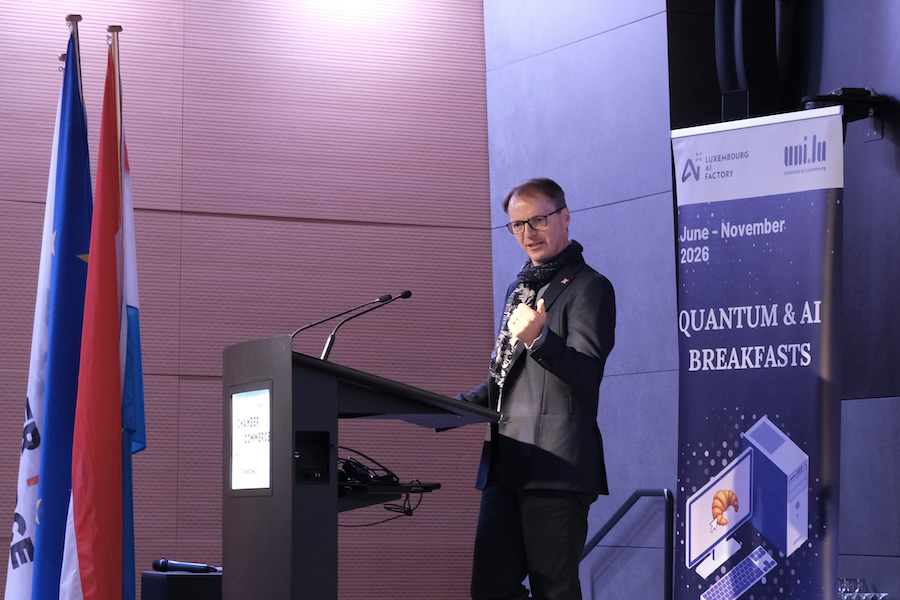
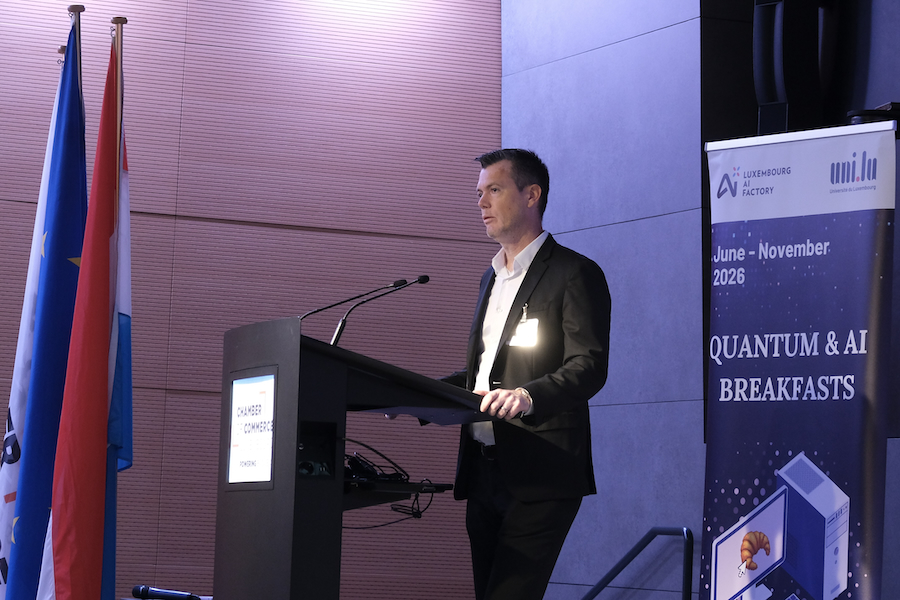
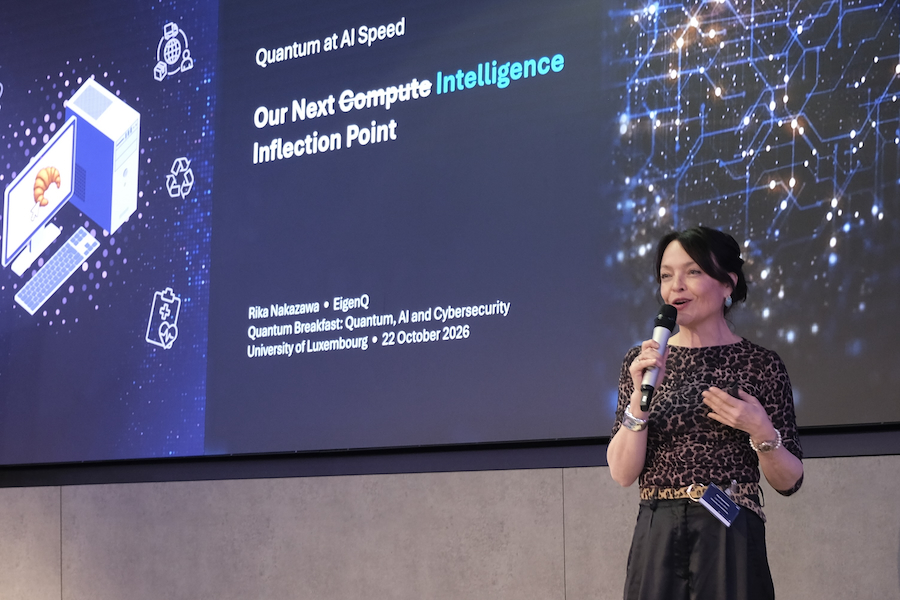
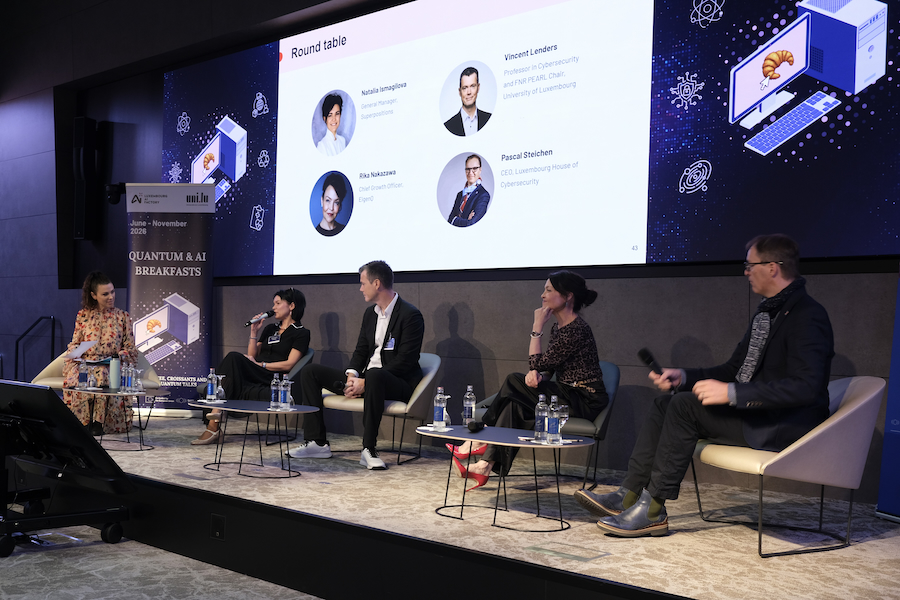
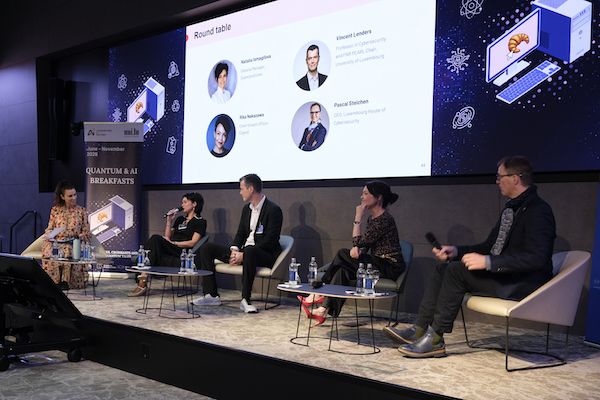
 (L-R) Lisa Burke, presenter; Natalia Ismagilova, General Manager, Superpositions; Vincent Lenders, Professor in Cybersecurity and FNR PEARL Chair, University of Luxembourg; Rika Nakazawa, Chief Growth Officer at EigenQ; Pascal Steichen, CEO of Luxembourg;
Credit: Steven Miler, Chronicle.lu
On Thursday 22 October 2026, the University of Luxembourg, in conjunction with the Luxembourg AI Factory, hosted the fourth of its current season of Quantum & AI Breakfast events at the Luxembourg Chamber of Commerce in Luxembourg-Kirchberg.
This edition of the quantum and artificial intelligence-based seminars focused on cybersecurity and featured contributions from Pascal Steichen, CEO of Luxembourg House of Cybersecurity; Natalia Ismagilova, General Manager, Superpositions; Vincent Lenders, Professor in Cybersecurity and FNR PEARL Chair, University of Luxembourg; and Rika Nakazawa, Chief Growth Officer at EigenQ.
The event, hosted by presenter Lisa Burke, began with a welcoming speech from Pascal Steichen who began by referencing the PHP vulnerabilities which have recently affected websites worldwide and noted that the discovery of the flaw(s) was a direct result of AI, demonstrating that we are in “a revolution” and that “the AI clock is ticking”.
Pascal Steichen stressed that emphasis must be placed on how to address the cybersecurity issues of the future. He noted that, at present, AI resides on both sides of the problem and in the future quantum technologies will also represent a threat. He detailed that the power of quantum computing in defeating existing security algorithms represents a real challenge, with data which is protected today being decryptable by quantum computers in the future.
Comparing the technologies he remarked: “While AI is accelerating threats against systems we use today, quantum is challenging the foundations on which our digital security has been built... Let's build cybersecurity that is secure by design, open by choice and resilient through collaboration.”
Vincent Lenders then spoke on AI-enabled cyber threats and the defence of critical infrastructure, first looking at how the development of supercomputers and machine learning have developed since the nineties to beat chess grand masters, then progressed to develop human-like traits such as “bluffing” to defeat poker champions, for AI to then learn to work collaboratively to beat teams of human players in strategy game environments such as Dota 2, and now how AI is now being used on a regular basis in ethical hacking competitions, and how human participants feel they have no choice but to utilise the technology if they know their opponents are permitted to use it. He posited: “What's the real consequence on cybersecurity? Cybersecurity is not a game. Cybersecurity is affecting our well-being in our society... What happens when AI surpasses human champions in cyber security?”
He added: “I strongly believe that we need to change our cyber defence concept. It is no longer going to be possible, first, to make sure that this critical infrastructure is secure by design, because there are just too many legacy systems and security problems. And it is no longer going to be possible to defend it with humans alone, because your humans will not have the same skill sets as agentic AI. So what we need is the defensive side also adopting some defensive AI just to protect your critical infrastructure.”
Vincent Lenders then asked if AI defences should be used to tackle AI attacks, how can we maintain human control, and what are the ethical implications of handing over control of systems such as critical infrastructure, e.g. power stations, to AI systems in the hope that they can maintain security?
He detailed that the University of Luxembourg has partnered with companies to help them to cope with the new challenges and develop solutions that could be helpful for them. He added that the university currently has around ten groups working on AI and cybersecurity topics, as well as offering a variety of Master programmes dedicated to cybersecurity studies.
In her presentation, Rika Nakazawa talked of her background in working for American technology company NVIDIA, and its move from designing graphics processing units to readopting the technology for use in AI infrastructure, through to her current role at US-based applied quantum technology company EigenQ, as well as her current studies at the University of Luxembourg.
She revealed that the influence for her current studies in computing comes from an article in Nature magazine on recent discoveries in the process of photosynthesis that revealed how this specific quantum phenomenon happens in a complex yet efficient manner when it comes to energy transfer. This, she said, has been attributed to quantum coherence - a key principle behind quantum computing, quantum sensors and other quantum technologies.
Rika Nakazawa also talked of AI and quantum working in tandem and detailed that connectivity, compute and intelligence architecture are becoming more heterogeneous and how this will merge with current systems, remarking: “There's been a paradigm shift over time that has lessons to tell us about how all of this is absorbed into existing infrastructure.”
She added: “When you think about this entire heterogeneous [system], you have to find the right balance between sovereignty, as we hear so much now in Europe, or the control of things, or the flexibility and agility that needs to happen, with anticipating how some of this infrastructure is going to come together.”
Additionally, Rika Nakazawa provided details about the work of EigenQ in the field of photonic-based quantum computing - that uses particles of light (photons) to carry and process quantum information instead of relying on electrical circuits or trapped atoms to make quantum bits (qubits). She also touched on the challenges for Europe in innovating and building AI and quantum infrastructure, compared to countries such as the US.
In closing, she said: “Imagination and collective action is going to be how we can drive things forward and where quantum computing becomes part of the fabric of everything that we do today.”
Following a short break, the event continued with a round table discussion moderated by Lisa Burke, which included contributions from Natalia Ismagilova, Vincent Lenders, Rika Nakazawa and Pascal Steichen, and focused on subjects such as quantum applications, the challenges of following research developments in the field, the problems of using AI as a research tool, how to use nature’s architecture to develop quantum technologies, the role and responsibilities of humans in the AI chain, how to build trust in autonomous systems and the democratisation of future digital technologies.
Closing remarks were given by Djamila Aouada, Deputy Director of SnT, University of Luxembourg, who said: “We often say Luxembourg is small, it is very well connected. That brings opportunities. In fact, we are very much in it. We can, we should debate the big picture and all these questions, but we cannot answer them all. We can see that today. There are still some questions up in the air. We will continue debating them. But as a country, I think the opportunity is here, it's real. We should really choose our battles, choose where we invest and put our energy, and do it well.”
She added: “AI is changing so fast. It is difficult. We have to be selective while being agile in our approach… We have to do it collaboratively. This is the strength of Luxembourg.”
The fifth and final Quantum Breakfast event of the year will take place on Thursday 26 November and will focus on the intersection of Quantum computing, AI and Space. Further information and registration details can be found at https://www.uni.lu/fstm-en/events/quantum-breakfast-quantum-ai-and-space/.