 Luxembourg Prime Minister Luc Friede;
Credit: Steven Miller, Chronicle.lu
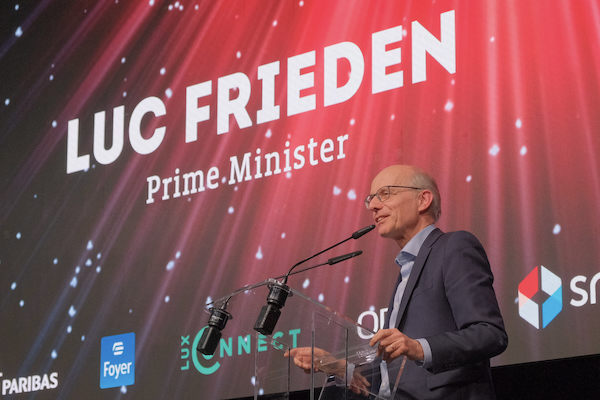
Luxembourg Prime Minister Luc Friede;
Credit: Steven Miller, Chronicle.lu
On Thursday 15 January 2026, the Fédération des Industries Luxembourgeoises (FEDIL) held its New Year’s Reception for businesses at LuxExpo in Luxembourg-Kirchberg.
The event welcomed Luxembourg Prime Minister Luc Frieden as well as prominent figures from across Luxembourg’s political and business sphere, and saw around 400 people in attendance.
The event began with an opening address from Georges Rassel, President of FEDIL, who first welcomed those in attendance before reflecting on FEDIL’s achievements in 2025, including a strengthening of international relationships and trade policy and the success of the FEDIL Industry Day. He also remarked on the potential impact of upcoming EU regulatory policies, the ongoing cost issues related to energy, the emergence of defence spending and Luxembourg’s industrial, digital and climate ambitions.
He said: “We are encouraged by recent successes in attracting additional industrial investments. Although this remains challenging, we firmly believe that robust framework conditions and rapid pragmatic responses are key to continued progress. Defence has emerged as a new driver. We are glad to see the government is supportive of new promising initiatives in that area. And more generally, industrial innovation, particularly achieving shorter times to market and offering quick plug-and-play solutions, is being constructively addressed within the whole community industry.”
Looking to 2026, Georges Rassel highlighted the importance of innovation, competitiveness and investment across Europe and against a backdrop of global political uncertainty. He also touched on the issues relating to social dialogue with Luxembourg’s trade unions and stated: “The workforce is a vital asset for our companies. How can anyone believe that the employers in this room treat their employees in the manner union leaders have recently suggested in their pamphlets and in their speeches? All sides must return to a respectful and constructive social dialogue if we are to revive the virtues of Luxembourg’s social model.”
In closing, he remarked: “This requires facing reality and identifying intelligent, sustainable long-term solutions to uncomfortable problems and ideally implementing them jointly. In doing so, we will relieve political decision-makers of a significant burden and we will all contribute to the stability and performance that have defined our country over the last decades and that distinguish us from neighbouring countries. Because stability will be essential if Luxembourg is to make the most of its opportunities.”
Adel Al-Saleh, CEO of SES, then gave a speech on “Space Innovation as the Foundation for Continued Growth: Transforming the Industry for Bigger Impact and Value Creation” during which he provided an overview of SES’s growth over the past ten years, its early adoption of SpaceX’s payload delivery vehicles, the recent acquisition of Intelsat and the importance of Luxembourg, not only as a base for SES’s operations but also as a major investor in the company.
He then detailed SES’s roadmap for the future, involving the development of MEO (Medium Earth Orbit) satellites, the need to improve supply chains, the importance of unified industry regulation worldwide and the ongoing importance of investment and attracting and retaining talent.
He said: “Our North Star as a company is to be a space solutions company. Take over our IP capabilities. We will be servicing beyond communications, and we will be taking control over our supply chain. And yes, we will be building manufacturing capability in Luxembourg. We will be moving from an operator into an industrial player. And we will do it here.”
The event concluded with an address by Prime Minister Frieden, who began by wishing everyone a happy and healthy new year before reflecting on how the world had changed socially and politically in the 40 years since he began his career, “a world in which the international rules-based order played a role”.
He reflected: “International law was what we believed in and borders could not be changed by force. The sovereignty of the nations in Europe and elsewhere, but for us in Europe, would be respected at all times. This world is being challenged. And we as a Luxembourg government, we do not like that and we will not accept it.”
Prime Minister Frieden then moved on to the government’s priorities for 2026 against this changing landscape: competitiveness, innovation and free trade.
He remarked: “Competitiveness is about surviving in an environment that is changing dramatically with competitors in Asia, in America and elsewhere. Competitiveness is about jobs. And I would like to thank you, all of you, who are creating jobs every day, who are maintaining jobs, who are making sure that families in this country can live with the money they bring home because that is what the economy is all about. So, we need competitiveness.”
He added: “If the world around us is getting more complicated, we as Luxembourg, we as the European Union, we need open markets. And for Luxembourg that means two things. One is that we need to work hard to make sure that the single market really is a single market. […] This is a country that has a social dialogue. This is a country where we have a budget, unlike some of our neighbours, and we have a predictable future. The companies that are in this country know that the policies that we decide today will be there tomorrow. It is not every morning where you need to check on the news whether there is a change, of course. We believe that this country is a good place to do business. It is a good place to create jobs. And you can count on our support to make this a success.”
Guests were then invited to enjoy a buffet dinner supplied by the organisers.