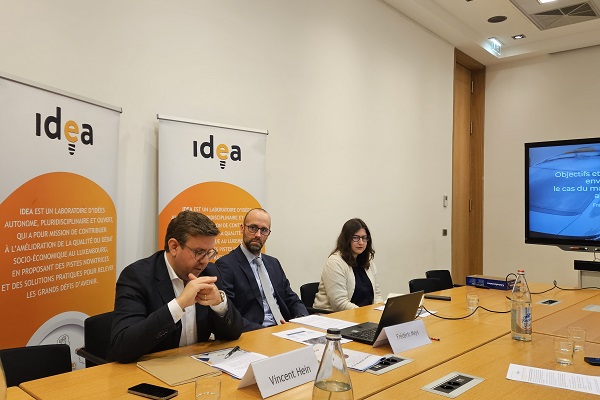
 (L-R) Vincent Hein, Director of Fondation IDEA; Frédéric Meys, economist at Fondation IDEA; n.c.;
Credit: Jazmin Campbell, Chronicle.lu
(L-R) Vincent Hein, Director of Fondation IDEA; Frédéric Meys, economist at Fondation IDEA; n.c.;
Credit: Jazmin Campbell, Chronicle.lu
On Wednesday 3 December 2025, the Luxembourgish think tank IDEA presented its new study on the objectives and effectiveness of environmental incentives, focusing specifically on electromobility, at a press conference at the House of Entrepreneurship in Luxembourg-Kirchberg.
This study examines the actual effectiveness of Luxembourg's financial incentives for electromobility and the challenges to overcome in order to achieve the objective set by the National Energy and Climate Plan (NECP): a fleet composed of 49% electric and plug-in hybrid vehicles by 2030. Despite a favourable context and substantial subsidies, the current pace of growth would not allow Luxembourg to reach this objective, the study found.
IDEA Director Vincent Hein introduced the study by explaining that it seeks to answer four main questions: Is Luxembourg on the right trajectory to reach its electromobility goals? Do current subsidies make electric vehicles (EVs) economically attractive compared to combustion-engine cars? What are the environmental benefits of these policies, and at what cost per tonne of CO2 avoided? Which additional measures could accelerate the transition and help achieve the NECP targets? He noted that the analysis is based on rigorous and concrete data aimed at enriching public debate.
IDEA economist Frédéric Meys then presented the main findings. He underlined that Luxembourg is well positioned in Europe yet still far from its NECP trajectory. The country's comparatively strong position is attributed to a relatively young vehicle fleet, high purchasing power, a relatively large share of company cars (22%) and a good charging infrastructure.
While EVs represented 29% of new registrations in the first half of 2025, they accounted for only 11.6% of the total fleet in May 2025. IDEA estimated that, at the current pace and without additional acceleration measures, the electric share of the fleet would reach only 17-20% by 2030 - well below the 49% target.
A comparative analysis of the total cost of ownership of fifteen pairs of internal combustion and electric vehicles (both purchased and leased) revealed several trends:
- with current subsidies, EVs are more financially advantageous in twelve out of fifteen cases, with an average saving of €1,255 over six years;
- without subsidies, EVs are more expensive in almost all cases, by an average of €4,145;
- electricity and fuel prices play a secondary role: the tested fluctuations rarely reverse the overall choice;
- leasing strengthens the competitiveness of EVs: in fourteen out of fifteen cases, it is cheaper to lease an EV than an internal combustion engine vehicle.
The study also found that vehicle taxation, particularly the road tax, is too low to influence behaviour, with an average difference of only €50 per year between internal combustion and electric vehicles.
In addition, IDEA assessed the climate effectiveness of incentives using the abatement cost method, measuring the cost per tonne of CO2 avoided for society as a whole (overall cost to the state and benefit to the consumer). Depending on the scope, the cost ranges from €393/tCO2 (national scope, excluding vehicle manufacturing) and €923/tCO2 (including the carbon footprint linked to production outside Europe and taking into account the environmental footprint of imported energy).
These levels are significantly higher than certain carbon pricing signals, such as Luxembourg's €40/tCO2 carbon tax and the approximately €75/tCO2 European Union Emissions Trading System (EU ETS) price. The study thus found that subsidies offer a high cost-benefit ratio.
The cost-reduction methodology - and more generally, the cost-effectiveness analysis of environmental policies - could be applied to other policies to create a useful basis for comparison when prioritising decarbonisation policies, according to the study.
IDEA noted that Luxembourg's policy remains heavily focused on incentives, while deterrent measures (widely used elsewhere in Europe) are still limited. The study has proposed several avenues for discussion to accelerate the transition:
- Introduce social leasing: announced and currently under review but not yet implemented, this would allow low-income households to access EVs without a high upfront cost;
- Deduct the subsidy directly at purchase: this would remove the obstacle of pre-financing by the buyer and eliminate the psychological barrier of the additional cost at the time of purchase;
- Implement low-emission zones or a modulated urban toll: measures adopted in many European cities that encourage the abandonment of polluting vehicles;
- Adapt vehicle taxation: a more pronounced modulation of the road tax or the introduction of an eco-registration tax would strengthen the financial incentive;
- Better inform the public about the total cost of ownership: greater visibility on the concrete benefits of switching to EVs could reduce some negative perceptions.
Frédéric Meys added that beyond electrification, mobility challenges in Luxembourg are more comprehensive, part of a larger debate that includes factors such as congestion, the needs of cross-border workers, land-use planning, modal shift and air quality.
Reducing the size of the vehicle fleet - through scrappage schemes, car sharing or the development of public transport - is also seen as a key structuring lever.
The analysis concluded that subsidies remain essential in making EVs more attractive from a financial perspective and Luxembourg is well positioned at the European level. However, without political changes, the country will not meet its 49% target by 2030. Other conclusions included:
- the tax aspect could play a role in making EVs more financially appealing;
- energy costs matter less than subsidies in determining competitiveness;
- abatement costs for the government (€533 to €1,252 per tonne of CO2 avoided) show that the policy is relatively expensive;
- new and perhaps less popular measures may be needed to reach the targets.
IDEA thus concluded that current subsidies are effective but insufficient to achieve Luxembourg's 2030 climate goals; the transition to electromobility now requires a more balanced combination of incentives, adapted taxation and regulatory measures, while respecting social acceptability.
The study Objectifs et efficacité des incitations environnementales: le cas du marché de l'électromobilité au Luxembourg can be viewed (in French) as a PDF here.