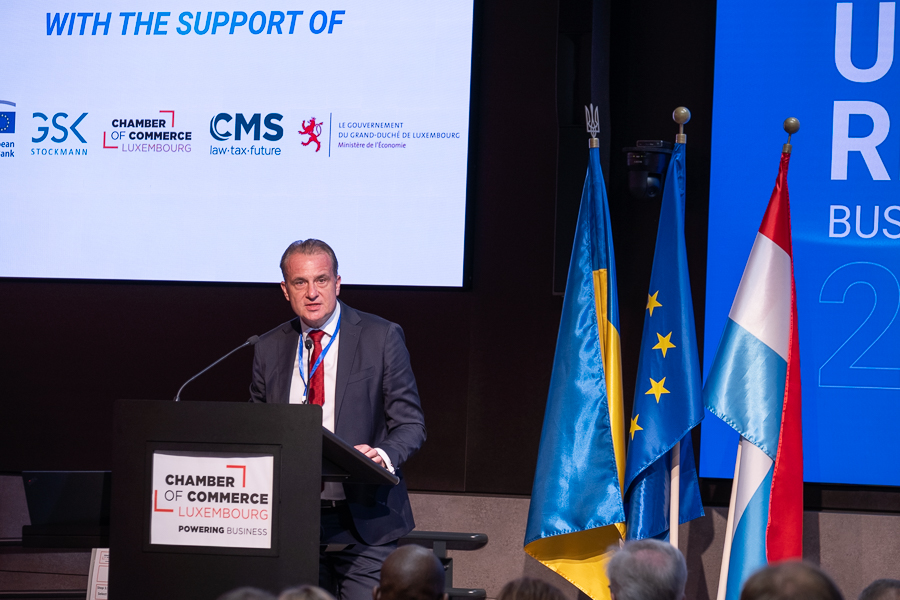
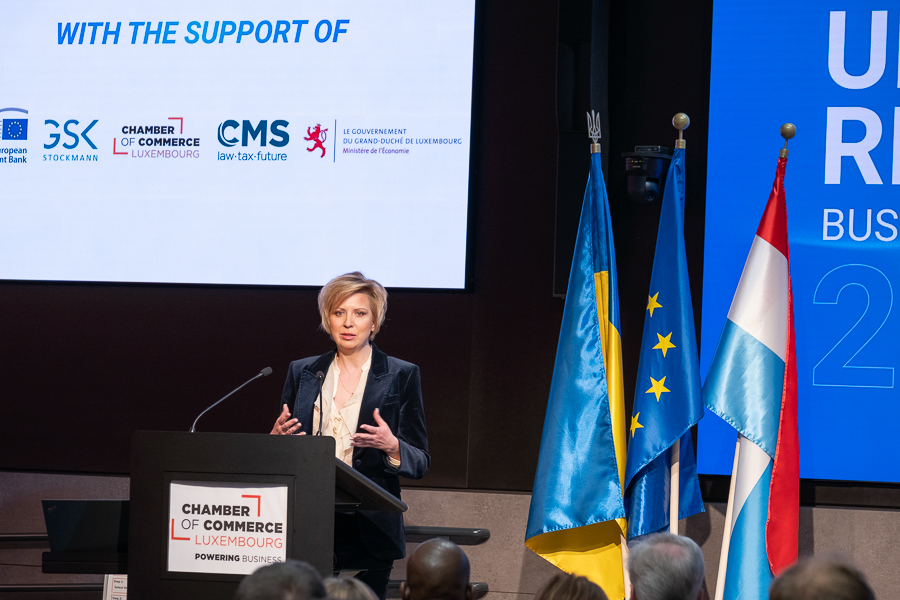
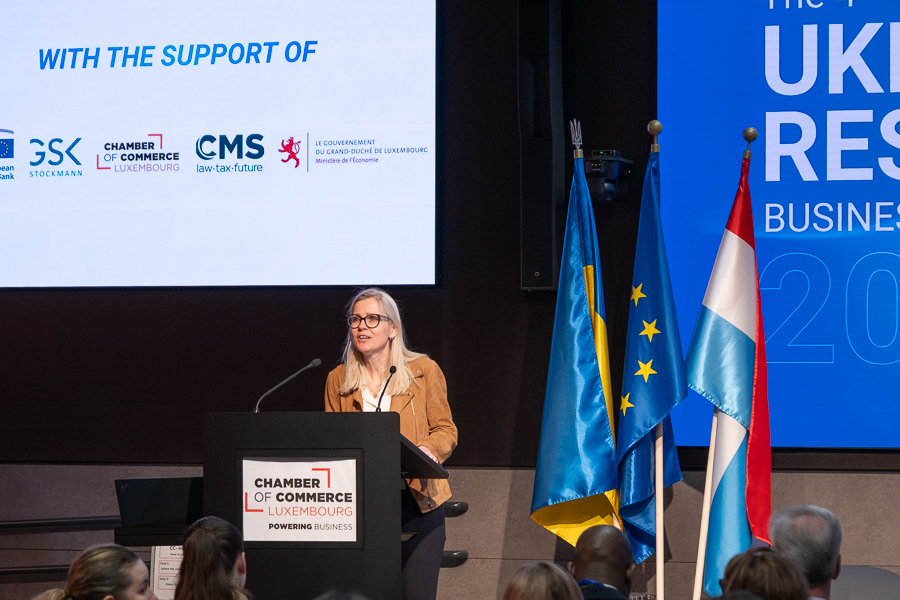
 (L-R) Evgenia Paliy, LUCC President; Olha Zykova, Deputy Minister of Finance of Ukraine; Mateo Rivellini, Head of Division at the Ukraine Investment Team at the EIB; Jonathan Taylor, Team Lead for the US URIF; Jan De Paw, Special Envoy Ukraine;
Credit: Ali Sahib, Chronicle.lu
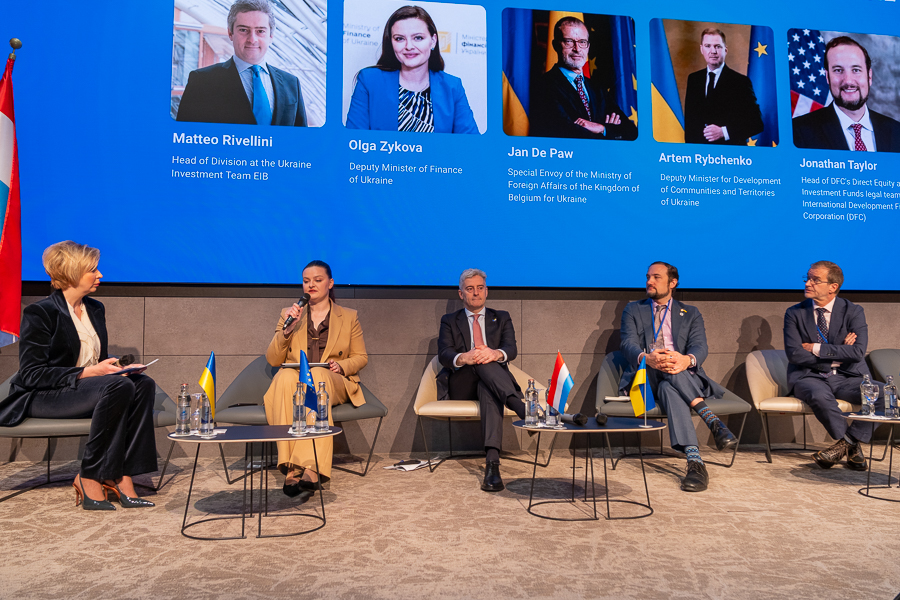
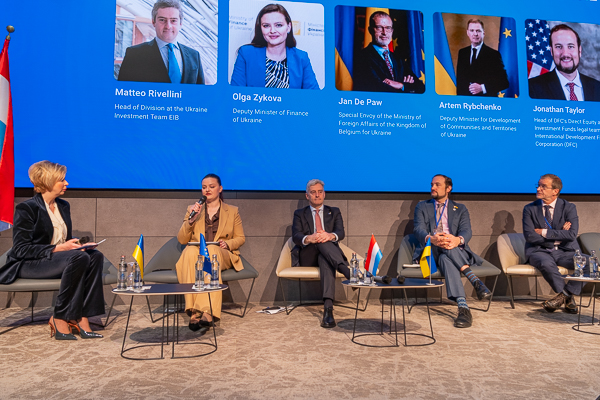
(L-R) Evgenia Paliy, LUCC President; Olha Zykova, Deputy Minister of Finance of Ukraine; Mateo Rivellini, Head of Division at the Ukraine Investment Team at the EIB; Jonathan Taylor, Team Lead for the US URIF; Jan De Paw, Special Envoy Ukraine;
Credit: Ali Sahib, Chronicle.lu
On Wednesday 4 March 2026, the fourth Ukraine Resilience Business Forum, organised by the Luxembourg-Ukraine Chamber of Commerce (LUCC), addressed issues related to reconstruction and investment cooperation between Luxembourg, the EU and Ukraine.
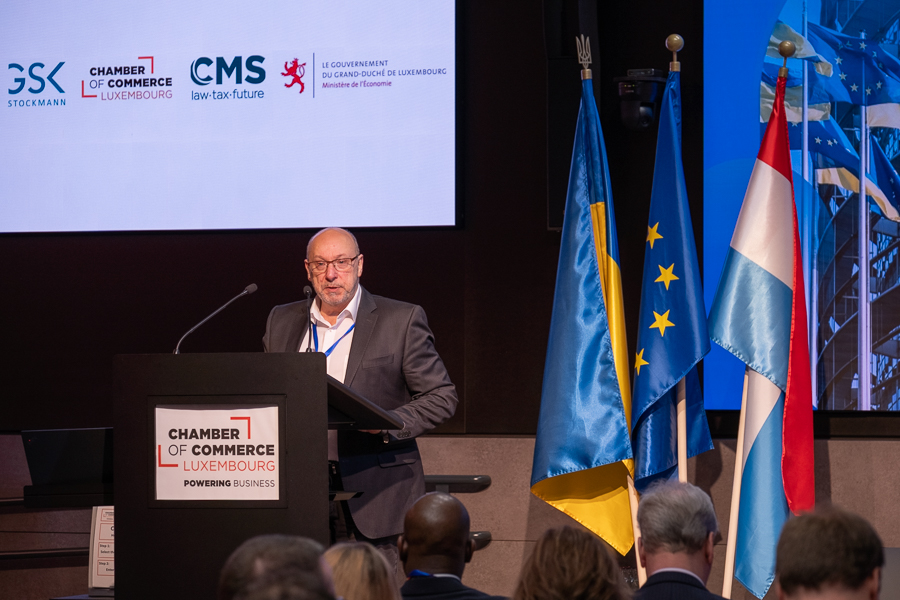
The event, which gathered around 300 participants, took place at the Luxembourg Chamber of Commerce in Luxembourg-Kirchberg, bringing together business leaders, policymakers, industry experts and guests from Ukraine.
The forum opened with a minute of silence in remembrance of all those who have fought and continue to fight for an independent Ukraine.
Cindy Tereba, CTO & Director International Affairs at the Luxembourg Chamber of Commerce, welcomed participants and underlined the role of the private sector in Ukraine’s reconstruction: “The private sector plays a critical role in Ukraine's reconstruction. Businesses drive innovation, boost efficiency and scale solutions. They create jobs, restore supply chains and help rebuild confidence.”
Olha Zykova, Deputy Minister of Finance of Ukraine, said the country’s economy had moved beyond survival mode despite the ongoing war: “Four years into a full-scale war, Ukraine is not operating anymore in survival mode. We are operating in the mode of reforms.” She noted that after the sharp contraction of 2022-2023, Ukraine had returned to growth, inflation had been brought down and the banking system remained highly liquid. She added: “The higher the pressure is, the stronger is the resilience. Each attack, each disruption has triggered structural upgrades in Ukraine.”
The forum was then formally opened by LUCC President Evgenia Paliy, who welcomed participants from Luxembourg, Ukraine, Italy, Austria, Poland and the United States: “Today, it is already the fifth year of resilience. There is no safe place in Ukraine. But the country stands, the business stands, people work, and they innovate. Ukraine is not fighting only for itself, we are fighting for Europe and for the future of Europe together.”
The first plenary panel, titled “Resilience of Ukraine’s Economy & Financing the Reconstruction”, focused on Ukraine’s economic resilience under extreme pressure, the role of the international financial safety net, public-sector reconstruction priorities and financing instruments aimed at unlocking large-scale recovery projects. The discussion featured Olha Zykova, Deputy Minister of Finance of Ukraine, Mateo Rivellini, Head of Division at the Ukraine Investment Team at the European Investment Bank (EIB), Jan De Paw, Special Envoy of the Ministry of Foreign Affairs of the Kingdom of Belgium for Ukraine and Jonathan Taylor, Team Lead for the US Ukraine Reconstruction Investment Fund (URIF).
Olha Zykova outlined the fiscal pressure under which Ukraine’s economy continues to operate during the war, noting that 27.2% of GDP, or more than $61 billion, is currently allocated to defence and security, leaving less than $40 billion for social spending and essential public services. She emphasised the scale of international support required: “Since the start of the war, external funding to Ukraine’s budget has reached more than $172 billion. However, around $40 billion per year remains the minimum required to maintain government services.”
Mateo Rivellini spoke about the European Investment Bank’s support for Ukraine since the full-scale invasion, particularly in municipal recovery projects, private-sector investment and emergency energy assistance. He also praised the work of Ukrainian institutions under wartime conditions: “The level of professionalism displayed by Ukrainian counterparts is unprecedented, especially given that the country has been under aggression for more than four years.”
Jonathan Taylor presented the US-Ukraine Reconstruction Investment Fund, a joint investment vehicle created by the US and Ukrainian governments to mobilise capital for reconstruction projects. The fund currently includes $150 million in seed capital and aims to attract additional financing for investments in Ukraine. “This is a binational private equity fund. It is something that has never been done before,” he said.
Jan De Paw discussed Belgium’s contribution to Ukraine’s recovery through export financing, development cooperation and support for small and medium-sized enterprises. Belgian initiatives currently focus on facilitating trade and developing partnerships in sectors such as energy, health and education. He noted that cooperation is often focused on smaller projects: “Most of our work is with SMEs, which represent around 80% of the Ukrainian economy.”
A separate conference session on information integrity examined the role of media during wartime and the growing challenges posed by disinformation. Speakers discussed how Ukrainian journalists continue to operate under wartime conditions while balancing ethical standards, censorship constraints and the need to counter large-scale information warfare. Particular attention was given to the spread of AI-generated content and deepfakes, as well as to cooperation between Ukrainian and European partners aimed at strengthening credible reporting and improving tools to detect and combat disinformation.
The forum also included discussions on Ukraine’s business climate and path towards EU accession, reforms aimed at improving the investment environment and rule of law, as well as developments in banking, finance and capital markets to mobilise reconstruction funding. Participants further explored municipal resilience initiatives, highlighting partnerships and projects supporting local communities and social infrastructure in Ukraine.