 (L-R) Oleksandr Kurdydyk; Anne Calteux; Veronica Garcia del Arco; Kristina Mikulova;
Credit: LUCC/Kateryna Mostova
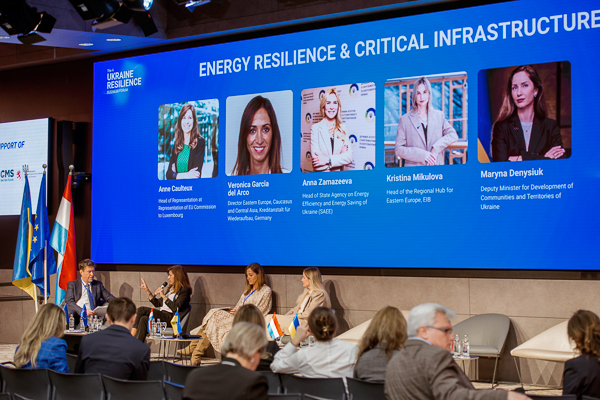
(L-R) Oleksandr Kurdydyk; Anne Calteux; Veronica Garcia del Arco; Kristina Mikulova;
Credit: LUCC/Kateryna Mostova
On Wednesday 4 March 2026, as part of the fourth Ukraine Resilience Business Forum, organised by the Luxembourg-Ukraine Chamber of Commerce (LUCC), a panel discussion took place on the topic of “Energy Resilience and Critical Infrastructure”.
The discussion, moderated by Oleksandr Kurdydyk, Partner at the global law firm DLA Piper, featured speakers including Anne Calteux, Head of the European Commission Representation in Luxembourg, Kristina Mikulova, Head of the Regional Hub for Eastern Europe at the European Investment Bank (EIB), Veronica Garcia del Arco, Director for Eastern Europe, Caucasus and Central Asia at Kreditanstalt für Wiederaufbau (KfW), and Mariia Malaia, First Deputy Head of the State Agency on Energy Efficiency and Energy Saving of Ukraine, who joined the discussion online.
Anne Calteux highlighted the scale of the European Union’s support for Ukraine since the start of Russia’s full-scale invasion, particularly in the energy sector, stressing that energy security has become a strategic priority for both Ukraine and the EU: “We have invested €195 billion in total since the start of the war, including financial, political, humanitarian and economic support. Of this amount, €3.7 billion comes from the proceeds of immobilised Russian assets. In the energy sector alone, we have provided around €3 billion since February 2022. We have delivered more than 11,000 generators since the start of the war, including 477 emergency generators in January 2026 alone. We also invested €977 million in emergency gas purchases during the winter of 2025/26, one of the harshest winters.”
She added that the EU is also working with international financial institutions to support Ukraine’s energy resilience while pursuing longer-term integration of Ukraine into the European energy system.
“We have worked closely with the European Investment Bank and the European Bank for Reconstruction and Development. For example, €50 million was provided to Naftogaz, and €500 million was mobilised ahead of winter 2025 to support Ukrainian energy security,” Anne Calteux explained. “At the same time, we are working on a longer-term perspective. In February 2025, we decided to integrate Ukraine into the European electricity market. This is not only about energy security but also about preparing Ukraine for EU accession.”
Kristina Mikulova highlighted both the resilience demonstrated by Ukrainians in maintaining energy infrastructure during the war and the scale of the European Investment Bank’s financial support for the country’s energy sector: “I visited the Tylihulska wind power plant in the Mykolaiv region about a year ago and was told how, during construction in freezing temperatures, cranes and equipment began to freeze. The team contacted the local military administration, which used drones to spray antifreeze so that construction could continue. To me, this is a powerful example of Ukrainian resilience and ingenuity. Since the full-scale invasion in February 2022, the European Investment Bank has invested more than €4 billion in Ukraine. In 2025 alone we reached a record €1.5 billion in financing, with more than half directed to the energy sector.”
She also described how investments have focused both on urgent crisis response and on strengthening the resilience of Ukraine’s energy infrastructure: “We supported key companies such as Naftogaz with €350 million backed by an EU guarantee and an additional €127 million grant from Norway. We also worked with Ukrenergo to protect critical transmission infrastructure and with UkrhydroEnergo to rehabilitate hydropower stations at Kaniv, Dnipro and Kremenchuk.”
Kristina Mikulova added that the EIB is increasingly focusing on decentralised and community-based energy systems: “At the same time, we are helping communities build decentralised and attack-resilient energy systems. Through a €200 million programme implemented with local banks, municipalities can apply for financing for district heating and renewable energy projects.” She stressed that energy resilience ultimately depends not only on infrastructure but also on people maintaining these systems under difficult conditions.
Mariia Malaia stressed that Russia’s attacks on Ukraine’s energy infrastructure have fundamentally changed the country’s approach to energy security: “Infrastructure has been subjected to systematic and repeated attacks, and entire segments of centralised generation have been lost. Rolling blackouts became a daily reality for citizens and businesses.” She added that this situation has accelerated Ukraine’s shift towards decentralised energy systems: “Incremental solutions are not enough. Energy should no longer be produced mainly at large centralised power plants, which are obvious military targets. It must increasingly be generated within communities, at enterprises, hospitals, water utilities and even individual households. This is not only an energy policy choice. It is a matter of national resilience.”
Mariia Malaia also highlighted new financial instruments introduced during the war to support energy efficiency and decarbonisation: “Our agency launched a new financial instrument dedicated to energy efficiency and decarbonisation projects, financed through the national CO₂ emissions tax. The Decarbonisation Fund of Ukraine has already supported 74 projects with more than ₴1.5 billion in state funding. These projects include solar power plants, energy storage systems, co-generation units and energy modernisation in industry and public buildings. The expected annual impact is about 135,000 megawatt-hours of energy generation or substitution and more than 40,000 tonnes of CO₂ emissions reduced.”
Veronica Garcia del Arco highlighted the role of international financial instruments in attracting private investment to Ukraine’s recovery and energy sector: “Following the full-scale invasion in 2022, we realised that in order to attract foreign and private capital we needed a new instrument. This led to the creation of the EU flagship fund, developed together with the European Commission and other European partners, which aims to leverage public funds and mobilise private investment for Ukraine’s reconstruction.”
She added that KfW has focused much of its support on maintaining essential services and strengthening Ukraine’s energy resilience: “Since 2022, we have committed around €1.6 billion across several sectors, with more than half directed to the energy sector. Our priority is to ensure that essential services such as electricity, heating, water and transport continue to function, particularly during winter and in regions exposed to repeated attacks. This includes support for rapid repairs, decentralised generation, grid stabilisation and stronger physical protection of critical infrastructure.”
Throughout the discussion, speakers underlined the importance of continued cooperation with Ukrainian partners in supporting the country’s energy resilience and long-term reconstruction. They stressed that sustained international support, investment and coordination remain essential for strengthening critical infrastructure and helping Ukraine move towards a secure, sustainable and European future.
To read about the opening ceremony and main plenary panel of the fourth Ukraine Resilience Business Forum, see: https://chronicle.lu/category/other-business-chambers/59899-4th-ukraine-resilience-business-forum-discussions-on-ukraines-economy-reconstruction.
IK