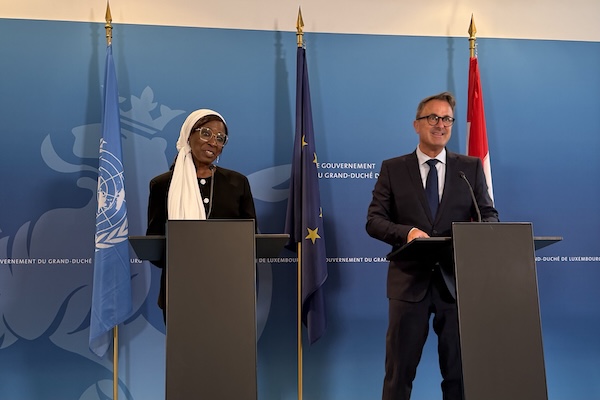
 (L-R) Diene Keita, United Nations Under-Secretary-General and Executive Director of UNFPA; Xavier Bettel, Luxembourg's Minister for Foreign Affairs and Foreign Trade and Minister for Development Cooperation and Humanitarian Affairs;
Credit: Ievgenii Karanov, Chronicle.lu
(L-R) Diene Keita, United Nations Under-Secretary-General and Executive Director of UNFPA; Xavier Bettel, Luxembourg's Minister for Foreign Affairs and Foreign Trade and Minister for Development Cooperation and Humanitarian Affairs;
Credit: Ievgenii Karanov, Chronicle.lu
On Thursday 3 September 2026, Luxembourg's Deputy Prime Minister, Minister for Foreign Affairs and Foreign Trade and Minister for Development Cooperation and Humanitarian Affairs, Xavier Bettel, held a joint press conference with Diene Keita, United Nations Under-Secretary-General and Executive Director of the United Nations Population Fund (UNFPA), in Luxembourg-Ville.
The press conference provided an opportunity to review the long-standing partnership between Luxembourg and UNFPA, which dates back to 2004, as well as current challenges related to sexual and reproductive health and rights, gender equality and the empowerment of women and young people.
Minister Bettel highlighted the scale of these challenges, noting that in 2024 some 250 million women living in developing countries still lacked access to modern contraception, while UNFPA data showed that a woman died every two minutes during pregnancy or childbirth in 2023. “That is the reality today,” he said. He added that, in 2025, UNFPA's work contributed to providing 295 million contraceptive supplies, preventing 66.1 million unintended pregnancies, supporting 8.5 million safe births in crisis-affected areas, preventing 142,000 maternal deaths and protecting 820,000 girls from female genital mutilation.
Referring to growing pressure on international cooperation, Minister Bettel stressed Luxembourg's continued commitment to the organisation and multilateralism. He said: "Luxembourg will continue to be a partner, Luxembourg will continue to support you, to defend multilateralism, to invest in equality, but also in rights."
Diene Keita highlighted the impact of Luxembourg's support for UNFPA, saying that it had helped save the lives of around 400 women over the past year. She added that almost 500,000 people had been reached through sexual and reproductive health services and around 850,000 people had been given access to contraceptive choices. She also underlined the importance of Luxembourg's core contributions, which allow UNFPA to direct resources towards particularly vulnerable populations. The organisation currently works in 150 countries and territories.
Addressing the organisation's financial situation, Diene Keita said UNFPA had lost slightly more than 25% of its resources. She added that, around eight months after launching its humanitarian appeal, only about 30% of the required funding had been mobilised. "It is crucial because people die when we do not intervene. [...] It is really urgent and every cent we receive will save someone's life," she said.
Asked where needs were currently most urgent, Diene Keita cited Afghanistan, Sudan, Somalia and Haiti, as well as the Sahel. She noted that Luxembourg has been one of the major donors to the Sahel and said its core funding continues to enable UNFPA to support vulnerable populations in the region despite current instability.
The discussion also addressed the UN80 reform process and the possibility of merging UNFPA with UN Women. Diene Keita explained that UN member states, including Luxembourg, had asked the organisations to examine alternatives to a full merger, particularly measures aimed at reducing administrative costs through shared offices and structures. She noted that member states are expected to continue discussing the issue during the September session.
Diene Keita also raised concerns about setbacks in rights and bodily autonomy in parts of the world, including issues such as female genital mutilation and discrimination against people based on their sexual orientation. She stressed that UNFPA continues to work with governments, parliaments and communities on these issues, adding: "We do not have the right today to subject a young woman to female genital mutilation. We do not have the right to ban a young man or a young woman because they have different orientations. It is not acceptable in 2026 to speak like that."