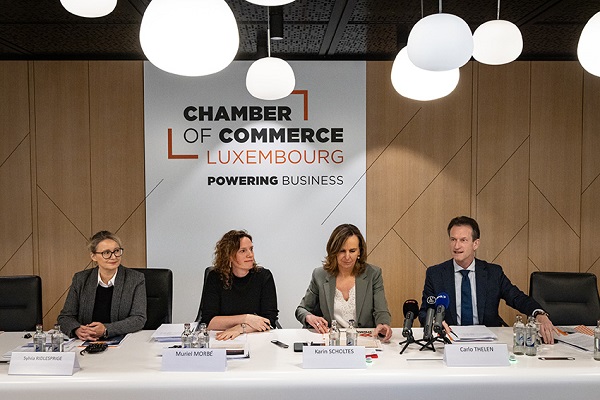
 (L-R) Sylvia Ridlesprige, General Affairs & Partnerships Manager; Muriel Morbé, Director of Talents & Skills; Karin Scholtes, Chair of the Talents Working Group; Carlo Thelen, Director General at Luxembourg Chamber of Commerce;
Credit: © Michel Zavagno / Blitz
(L-R) Sylvia Ridlesprige, General Affairs & Partnerships Manager; Muriel Morbé, Director of Talents & Skills; Karin Scholtes, Chair of the Talents Working Group; Carlo Thelen, Director General at Luxembourg Chamber of Commerce;
Credit: © Michel Zavagno / Blitz
On Tuesday 2 December 2025, the Luxembourg Chamber of Commerce presented 34 recommendations aimed at strengthening talent attraction and retention in the Grand Duchy.
According to estimates from the General Inspectorate of Social Security (IGSS), Luxembourg will need 335,000 new hires across all sectors by 2040: 180,000 to replace retirees and 155,000 to fill newly created positions. The Chamber of Commerce thus highlighted a major challenge: a persistent talent shortage that weakens the performance and dynamism of the economy and threatens the competitiveness of businesses. Without an ambitious strategy to attract, retain and develop skills, Luxembourg risks a continued slowdown in its growth.
To address this, the Luxembourg Chamber of Commerce presented its strategic report, "Talent4Luxembourg", on Tuesday. Prepared under the chairmanship of Karin Scholtes, Chair of the Talents Working Group, the report proposes 34 concrete recommendations, structured around six priority areas, to strengthen Luxembourg's attractiveness to talent and their families, secure key skills and anticipate the impacts of demographic ageing.
The aim is to support the development of a true "Talent Hub", capable of attracting, integrating and retaining talent for Luxembourg's economic sector.
Carlo Thelen, Director General of the Luxembourg Chamber of Commerce, stated: "Ensuring the sustainability and competitiveness of our economy requires clear guidelines and targeted measures to guarantee the availability of the diverse profiles sought by businesses, in the face of increased international competition due to demographic ageing in Europe and local competition resulting from high salary levels for certain careers in the sheltered public sector."
With 74% of employees in Luxembourg being foreign nationals, attracting talent is only part of the challenge: the Chamber of Commerce emphasised the need for action to secure the skills that underpin Luxembourg's competitiveness and support the ongoing diversification of its economy. This requires two priorities: strengthening the country's attractiveness (particularly that of the private sector) for international talent and their families and fully mobilising the local talent pool, from younger generations to senior professionals.
Karin Scholtes stressed the urgency to "act in a concerted manner to quickly and effectively implement a concrete national 'Talent' strategy and ambitious initiatives. Leveraging artificial intelligence is a major opportunity to increase productivity and simplify recruitment processes."
To pragmatically address talent-related challenges, several projects are currently under development and will launch in the coming months. They aim to enhance the country's international visibility and improve support for international talent, their families and Luxembourg companies.
Muriel Morbé, Director of Talents & Skills at the Chamber of Commerce, praised "the collective commitment of the Ministry of the Economy and the stakeholders involved in the projects, particularly the establishment of a one-stop shop to simplify the attraction and integration of talent, as well as the development of a 'Spouse Programme' to support and assist spouses in familiarising themselves with the country and integrating into the local job market." She added: "Luxembourg must become a true 'Talent Hub', capable of attracting, integrating and retaining the talent our economy needs."
The Chamber of Commerce's 34 recommendations are structured around the following six strategic directions:
- Develop a talent overview to anticipate the skills sought and strengthen those already available
- Position Luxembourg as an attractive international Talent Hub for talent and their families
- Simplify and expedite administrative procedures related to the arrival and integration of international talent
- Create an environment conducive to the settlement and integration of talent and their families
- Value the experience of talent aged 45+ and 55+ as a strategic resource
- Strengthen the skills necessary for the continued diversification of the economy (e.g. defence, AI, health technologies)
For the full report, click here.