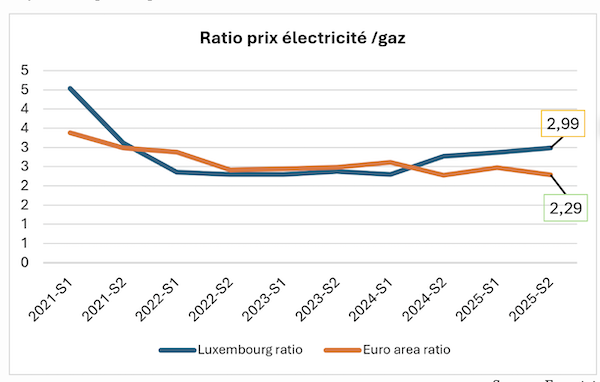
 The ratio between electricity and gas prices;
Credit: Eurostat
The ratio between electricity and gas prices;
Credit: Eurostat
On Thursday 27 August 2026, Luxembourg-based think tank IDEA published a new analysis, Décryptage No 61, examining Luxembourg's position in relation to the European Union (EU)'s electrification targets.
On Friday 17 July 2026, the European Commission presented its EU Electrification Action Plan, accompanied by a revision of the European Emissions Trading System (ETS). The stated ambition is to make Europe the “first electrified continent” by increasing the share of electricity in final energy consumption to 32% in 2030 and 46% in 2040.
According to the indicator used by the European Commission, Luxembourg ranks among the least electrified EU Member States, with electricity accounting for only 14.9% of final energy consumption in 2024.
However, IDEA noted that this situation is largely influenced by fuel tourism, which artificially increases road fuel consumption recorded in national statistics. Once this effect is partially neutralised, Luxembourg's electrification rate moves closer to the European average.
The situation also varies considerably between sectors. Luxembourg's industry already has a level of electrification above the European average, while there remains significant potential for progress in residential heating and transport.
IDEA noted that economic conditions in Luxembourg are gradually becoming more favourable to electrification. Recent adjustments to the Klimabonus Wunnen scheme, the extension of subsidies for heat pumps and energy renovation, as well as measures for the pre-financing of subsidies, are helping to reduce financial barriers.
Regarding mobility, the running costs of electric vehicles (EV)’s are now competitive compared with combustion-engine vehicles, while falling purchase prices, the pre-financing of the purchase subsidy and the announced introduction of social leasing are expected to support their uptake.
Despite progress in the adoption of EV’s, IDEA reported that Luxembourg still has a relative shortage of public charging infrastructure. The development of private charging points, particularly in jointly owned residential buildings, was identified as an important avenue for accelerating the transition.
IDEA also noted that, although the electricity-to-gas price ratio remains favourable to electrification, gas prices for Luxembourg households are 47% lower than the European average, which could reduce the incentive to transition.
IDEA added that the revision of the ETS and the creation of a European Industrial Decarbonisation Bank, with a target of mobilising €100 billion, could offer new opportunities for Luxembourg companies.
Luxembourg's industry already has a relatively high level of electrification, with several projects supported by the national authorities relying on the electrification of industrial processes. According to IDEA, the challenge will now be to take advantage of new European instruments to strengthen this momentum.