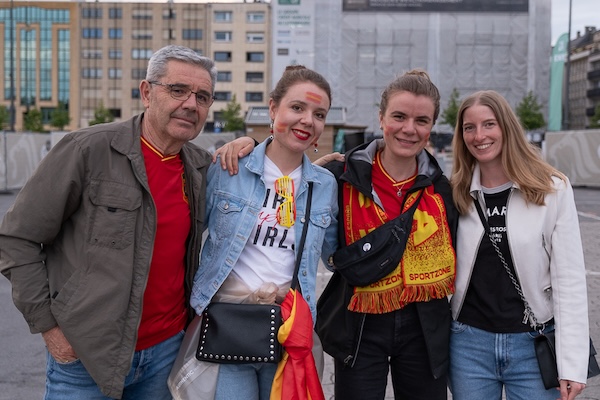
 Spanish football fans during a public viewing of the Women’s EURO 2025 semi-final in Luxembourg City, 23 July 2025;
Credit: Ali Sahib, Chronicle.lu
Spanish football fans during a public viewing of the Women’s EURO 2025 semi-final in Luxembourg City, 23 July 2025;
Credit: Ali Sahib, Chronicle.lu
As the FIFA World Cup continues to expand and include more national teams than ever before, it is becoming increasingly inaccessible for many European supporters who wish to travel and follow their national teams in person, a paradox that merits closer examination ahead of the 2026 tournament.
I witnessed a similar dynamic first-hand at the 2022 World Cup in Qatar, which I covered on the ground throughout the tournament. During the opening matches of the group stage, organisers relied heavily on groups of neutral spectators, who were provided with team merchandise and directed to stadia in order to ensure full stands and favourable television images.
This was particularly noticeable at matches involving European national teams. Many European supporters chose not to travel to the West Asian host country for a variety of reasons, a sentiment echoed in numerous conversations I had with fans in Qatar. Demand was also reflected in the secondary ticket market, where tickets for several group-stage matches featuring European teams were often available shortly before kick-off, sometimes at prices around 50% higher than face value.
Naturally, matches involving the host nation or teams from the region, including Saudi Arabia, as well as Morocco, Argentina and a handful of other national sides, attracted full stadia. I also recall that during the tournament, Qatari authorities introduced temporary travel restrictions affecting Moroccan supporters, after Morocco’s football federation had promised free tickets to fans for the historic semi-final against France.
For those holding a local Qatari ID, the cheapest tickets during the group stage were available at prices starting from around €10. Many of these tickets later appeared on the secondary market shortly before kick-off.
Turning to the first World Cup to feature 48 teams (FIFA World Cup 26 in Canada, Mexico and the USA), early indications suggest a very different pricing landscape. On Thursday 11 December 2025, FIFA released initial ticket price information to participating member associations, including through official channels such as national Football Associations.
According to information published by the Scotland Supporters Club (SSC), FIFA has set three ticket categories for supporters allocated through national associations: Supporters Premier Tier (Category 1), Supporters Standard Tier (Category 2) and Supporters Value Tier (Category 3). The SSC noted that ticket prices, allocations and pricing strategies are determined exclusively by FIFA, with national associations having no influence over the final cost.
Figures released via the same channels illustrate the scale of the increase. For group-stage matches, ticket prices range from $180 in the Supporters Value Tier to between $500 and $700 in the Premier Tier, depending on the opponent and match profile.
The price escalation becomes even more pronounced in the knockout phase. Tickets for the Round of 32 start at $235 in the lowest category and rise to $610 in Category 1. By the semi-finals, prices reach $920 in the Supporters Value Tier and $3,170 in the Premier Tier, while tickets for the final are listed at $4,185 in the lowest supporters’ category and as much as $8,680 in the top tier.
Following criticism over the initial pricing structure, FIFA reacted and later announced the introduction of a new, lower-priced ticket category. On Tuesday 18 December 2025, the governing body confirmed that a newly created “Supporter Entry Tier” price category would offer tickets at a fixed price of 60 for all 104 matches of the FIFA World Cup 2026, including the final.
According to FIFA, the new tier is intended to make attending the tournament more affordable for supporters following their national teams. These tickets will be distributed through Participating Member Associations (PMAs), which will define their own eligibility criteria, with FIFA stating that priority should be given to loyal supporters closely connected to their national teams. FIFA also confirmed that half of each PMA’s allocation will fall within the most affordable categories.
The announcement came amid exceptionally high demand, with FIFA reporting that around 20 million ticket requests had already been submitted during the current random selection draw phase. This sales phase remains open until Tuesday 13 January 2026 at 17:00.
Beyond ticket prices, travelling supporters will also face significant additional costs linked to the tournament’s geographic spread. Several European national teams are scheduled to play group-stage matches across multiple cities and even different countries. Scotland, for example, are set to play two matches in Boston and one in Miami - at least these are all on the East Coast USA. France and England will both feature in New York/New Jersey and Boston, with France also playing in Philadelphia and England in Dallas. Meanwhile, Germany’s fixtures will take place across Houston, Toronto (Canada) and New York/New Jersey. Spain, meanwhile, have two matches in Atlanta but will also travel to Mexico, where they are due to face Uruguay in Guadalajara. Should these teams progress to the knockout stages, supporters would need to factor in further travel across the host countries, adding another layer of logistical and financial complexity to following their national sides at the 2026 World Cup.
While supporters face rising costs and complex logistics, the financial incentives for participating teams and national associations are moving in the opposite direction. On Wednesday 17 December 2025, FIFA confirmed that a total of $655 million will be distributed as prize money among the 48 teams at the 2026 World Cup, marking a 50% increase compared to the previous edition. The champions will receive $50 million, while the runners-up will earn $33 million. The team winning the third-place play-off will be awarded $29 million, with the losing side receiving $27 million.
Teams reaching the Round of 32 will earn $11 million, those progressing to the Round of 16 will receive $15 million, while teams eliminated at the quarter-final stage will each be paid $19 million. In addition, every qualified team will receive $1.5 million to cover preparation costs, meaning that each Participating Member Association is guaranteed at least $10.5 million for taking part in the tournament.
Looking back at FIFA’s ticket pricing strategy, a useful reference point can be found in the 2025 Club World Cup, which took place in the United States earlier this year and featured 32 teams. During that tournament, ticket prices were notably adjusted as the competition progressed. While knockout matches were initially listed on platforms such as Ticketmaster at several hundred US dollars, prices gradually fell, first below the $100 mark and later to just a few dozen dollars. Ensuring full stadia and showcasing the popularity of “soccer” in the US market appeared to take precedence, particularly in the build-up to the 2026 World Cup, the sport’s flagship event held every four years.
Another practical challenge for European supporters will be kick-off times. With matches spread across Canada, the United States and Mexico, time differences of between six and nine hours will significantly affect viewing schedules in Europe. While some fixtures will still be accessible in the evening, many others will take place late at night or in the early hours of the morning.
The opening match of the tournament, for example, between Mexico and Saudi Arabia, is scheduled for 13:00 local time, which corresponds to 21:00 in central Europe (CET). However, the second match on the same day, featuring South Korea against one of Denmark, North Macedonia, Czechia or Ireland, is set to kick off at 04:00 CET (Central European Time). As a result, several matchdays will include multiple fixtures starting after midnight for European audiences.
This pattern becomes even more apparent on subsequent matchdays. On the third matchday, Brazil against Morocco is scheduled for midnight CET, followed by Haiti v Scotland at 03:00 and Australia against one of Turkey, Romania, Slovakia or Kosovo at 06:00. Similar kick-off times of 01:00 and 04:00 are expected throughout the group stage, making it increasingly difficult for European supporters to follow matches live, particularly on workdays.
Taken together, the experience of Qatar 2022 and the emerging realities of the 2026 tournament point to a growing disconnect between the World Cup’s global expansion and its accessibility for travelling European supporters. While more teams and more matches promise a broader sporting spectacle, rising ticket prices, complex travel logistics across multiple countries and unfavourable kick-off times risk further limiting the number of fans able to follow their national teams in person or even comfortably from home. As FIFA continues to reshape its flagship tournament, the challenge will be to ensure that growth does not come at the expense of the very supporters whose passion underpins the World Cup’s global appeal.