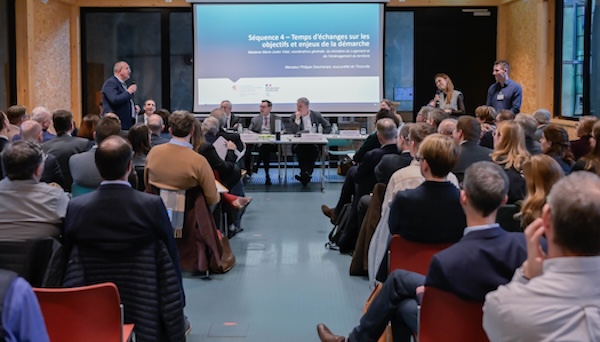
 (centre, L-R) Yves Séguy, Prefect of Meurthe-et-Moselle; Pascal Bolot, Prefect of Moselle; Claude Meisch, Luxembourg's Minister of Housing and Spatial Planning;
Credit: MLOGAT
(centre, L-R) Yves Séguy, Prefect of Meurthe-et-Moselle; Pascal Bolot, Prefect of Moselle; Claude Meisch, Luxembourg's Minister of Housing and Spatial Planning;
Credit: MLOGAT
Luxembourg’s Ministry of State together with the Ministry of Housing and Spatial Planning recently launched an event of the Franco-Luxembourg working group on cross-border spatial planning, taking place at Ellergronn in Esch-sur-Alzette.
Held on Friday 13 March 2026, the meeting was co-chaired by Claude Meisch, Minister of Housing and Spatial Planning, and Pascal Bolot, Prefect of Moselle.
The ministries stated that this initiative follows the Franco-Luxembourg Intergovernmental Commission and the joint declaration of intent signed on 11 December 2025, which confirmed a shared willingness to strengthen cooperation and to better coordinate spatial planning policies within the cross-border area.
In a context shaped by economic and demographic dynamics, the working group aims to improve mutual understanding of planning documents, to establish a shared territorial diagnosis and to define a common strategic territorial vision to benefit residents on both sides of the border. On this occasion, both ministers highlighted the importance of structured, balanced and pragmatic cooperation based on a common working method, clear governance and the search for concrete and shared solutions.
“Faced with the economic and demographic dynamics shaping our cross-border living area, it is essential to strengthen territorial cooperation based on trust, shared knowledge and a common vision. The launch of this Franco-Luxembourg working group marks an important step towards better coordinated spatial planning between France and Luxembourg, serving residents on both sides of the border and supporting sustainable and balanced development of our shared territory,” stated Minister Meisch.
The event was attended by elected representatives from the municipal, intermunicipal, departmental and regional levels. Cross-border stakeholders also took part, with technical teams supporting discussions.
The organisers presented the first methodological foundations and work priorities, with contributions from the Luxembourg Institute of Socio-Economic Research (LISER) and the urban planning agencies AGAPE and AGURAM. The group stated it will focus on housing, public transport and local services, demography and the preservation of resources, particularly water and land, with an approach, designed to combine a broad framework for exchange with a more focused working format to feed the diagnosis and to identify shared priorities. The group noted it will next consolidate the joint diagnosis and then launch thematic work following a progressive timeline.
According to ministries, this initiative marks a step towards a more coordinated cross-border spatial planning strategy between France and Luxembourg and supports quality of life and sustainable development in the cross-border living area.