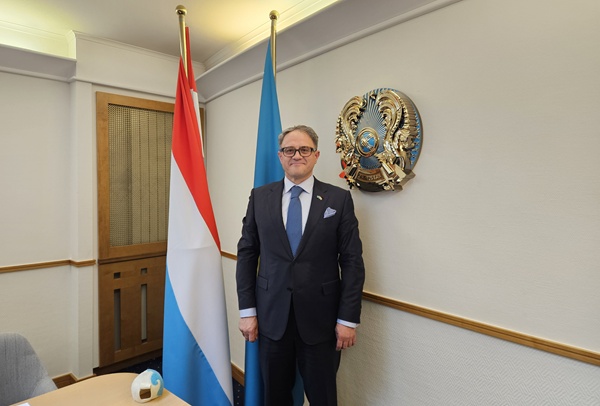
 Roman Vassilenko, Ambassador of Kazakhstan to Belgium and Luxembourg;
Credit: Jazmin Campbell, Chronicle.lu
Roman Vassilenko, Ambassador of Kazakhstan to Belgium and Luxembourg;
Credit: Jazmin Campbell, Chronicle.lu
Earlier this week, on Monday 11 May 2026, the Ambassador of Kazakhstan to Belgium and Luxembourg, Roman Vassilenko, held a press briefing at the Consulate of Kazakhstan in Luxembourg.
A small group of journalists attended the introductory discussion with Ambassador Vassilenko and his colleagues.
The ambassador officially presented his credentials to Grand Duke Guillaume of Luxembourg on 12 March 2026. Despite being a non-resident ambassador based in Brussels, he said he intended to visit Luxembourg once every two months, to "be present as much as possible" and meet with representatives from the Luxembourg government, the Foreign Ministry and parliament, as well as private companies. This marked his first official visit to the Grand Duchy since assuming his post.
Ambassador Vassilenko also serves as Head of the Mission of Kazakhstan to the European Union (EU) and the North Atlantic Treaty Organization (NATO). Prior to his appointment, he served as Kazakhstan's Deputy Minister of Foreign Affairs from 2022.
During the press briefing, Ambassador Vassilenko presented Kazakhstan as a country seeking to balance complex geopolitical realities while promoting internal stability, regional cooperation and pragmatic diplomacy centred on national interests. He highlighted Kazakhstan's longstanding "multi-vector" foreign policy, maintaining close ties with neighbouring Russia and China while also strengthening cooperation with the EU and other Western partners. He also reiterated his country's support for a system based on multilateralism and international law.
The ambassador described relations with Luxembourg as positive and developing steadily, both bilaterally and through EU cooperation. He referred to recent high-level exchanges between Kazakhstan and Luxembourg, including meetings between President Kassym-Jomart Tokayev and Luxembourg's Prime Minister Luc Frieden on the sidelines of the UN General Assembly in New York. He also expressed hope that Luxembourg would soon complete the ratification process for a visa-free travel agreement covering holders of service passports within the Benelux countries.
Ambassador Vassilenko presented key political reforms underway in Kazakhstan. He described constitutional changes approved by referendum in March 2026 as part of a broader effort to build a "just Kazakhstan". He explained that the reforms would transition Kazakhstan towards a unicameral parliament under a new constitutional framework, while a new People's Council representing the country's many ethnic groups would serve in an advisory role and have the power of legislative initiative.
The ambassador also underlined the growing strategic importance of relations between Kazakhstan and the EU, particularly since Russia's invasion of Ukraine in February 2022. He noted that the EU remains Kazakhstan's largest trade and investment partner, with cooperation expanding in areas such as transport and logistics, renewable energy and critical raw materials. He highlighted the development of the so-called "Middle Corridor" transport route linking Asia and Europe, as well as Kazakhstan's significant reserves of critical minerals sought by European industries.
Ambassador Vassilenko also stressed Kazakhstan's importance as an energy supplier to Europe, describing the country as one of the EU's top three external oil suppliers alongside the United States (US) and Norway. He noted that most Kazakh oil exports transit through Russian infrastructure, including the Caspian Pipeline Consortium route to the Black Sea, adding that these exports had remained unaffected despite sanctions linked to the war in Ukraine.
Discussing economic relations with Luxembourg specifically, Ambassador Vassilenko noted that Luxembourg companies have invested around €4 billion in Kazakhstan. He pointed to opportunities for further cooperation in sectors including renewable energy, agriculture, transport and logistics, manufacturing and space technologies, mentioning ongoing discussions with SES (whose premises he visited earlier on Monday) regarding connectivity projects in remote areas of Kazakhstan.
Ambassador Vassilenko also highlighted improved cooperation among the five Central Asian countries, describing a shift from regional rivalry towards closer dialogue and coordination over the past decade. He noted growing international interest in the region through various "Central Asia Plus" cooperation formats involving partners such as the EU, the US, China and Gulf countries.
The ambassador went on to reflect on Kazakhstan's history and identity, including the country's ethnic diversity and its efforts to maintain interethnic harmony among more than 100 ethnic groups. He stressed that preserving "peace and harmony" remains a central pillar of Kazakhstan's policy. Referring to the war in Ukraine, he reiterated Kazakhstan's support for diplomacy and dialogue, emphasising the importance of stability and predictable international relations for countries situated between larger powers.
During the Q&A session, Ambassador Vassilenko was asked whether Kazakhstan feared possible Russian aggression similar to the invasion of Ukraine. He replied that Kazakhstan and Russia had fully delimited their 7,500-kilometre border through a treaty signed in 2002, effectively resolving the "border issue". He also highlighted Kazakhstan's approach to managing ethnic diversity and promoting coexistence between different communities, including the country's sizeable ethnic Russian population. He had earlier spoken of how the country had worked hard over the years to achieve "excellent" relations with both Russia and China, even if certain issues remain. "We work with our immediate neighbours on resolving issues before they become problems," he said.
Ambassador Vassilenko concluded by reiterating Kazakhstan's commitment to multilateralism, international law and constructive engagement with all partners.
JCA