 Credit: Lise Bockler / Greenpeace
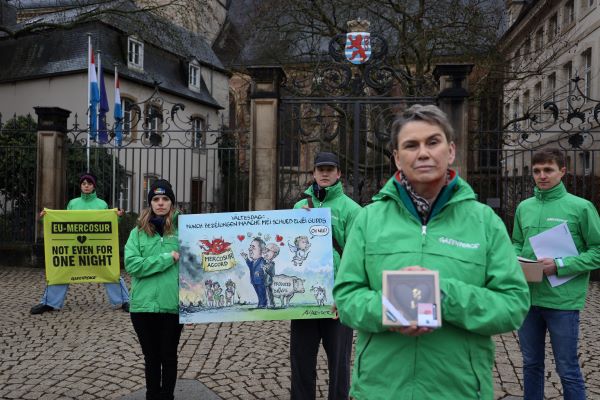
On Friday 13 February 2026, Greenpeace Luxembourg presented a giant caricature and a heart-shaped chocolate to the government to symbolically denounce its “toxic” relationship with the EU-Mercosur Agreement.
According to Greenpeace, on the eve of Valentine’s Day, activists from the organisation displayed a banner with the text “EU-Mercosur: Not even for one night”. The statement opposed any provisional application of the agreement, which the European Commission plans to impose despite reservations expressed by the European Parliament (EP).
Greenpeace recalled that on Wednesday 21 January 2026, MEPs from the EP, in a close vote, expressed doubts about the compatibility of the EU-Mercosur agreement with the EU’s founding treaties and climate commitments, and referred it to the Court of Justice for review. Despite this, Ursula von der Leyen and several leaders, in particular German Chancellor Friedrich Merz, considered imposing the provisional application without waiting for the Court’s opinion.
“Such democratic denial would be unacceptable. Especially since the current context makes this agreement even more harmful,” said Gauthier Hansel, campaign officer at Greenpeace Luxembourg. “At the beginning of January, the Brazilian association of vegetable oil industries (ABIOVE) announced its withdrawal from the moratorium protecting the Amazon, one of the most effective anti-deforestation tools. Its disappearance could lead to 30% additional deforestation by 2045. At the same time, the European regulation against deforestation has been postponed by another year. Applying the EU-Mercosur agreement under these conditions would add fuel to a fire already burning in the Amazon rainforest.”
According to Greenpeace, the economic benefits announced do not justify such sacrifices. The organisation noted that the European Commission’s own estimates showed that the agreement would generate only 0.05% growth in EU GDP by 2040, benefiting only a few large industries. For this “minimal” gain, Europe would accept agricultural imports that would threaten small and medium-sized farms, unable to compete with South American producers operating under far lower standards.
“After 25 years of negotiations, we must admit that this agreement no longer meets the challenges of our time. Fair international trade that respects the environment and human rights remains not only possible but necessary. This treaty does not belong to that vision,” Gauthier Hansel continued. “A parliamentary question was submitted on 22 January to clarify the government’s position on provisional entry into force. We now expect Foreign Affairs Minister Xavier Bettel to publicly oppose this early application and act accordingly with his European counterparts. France has shown the way. Luxembourg must follow.”