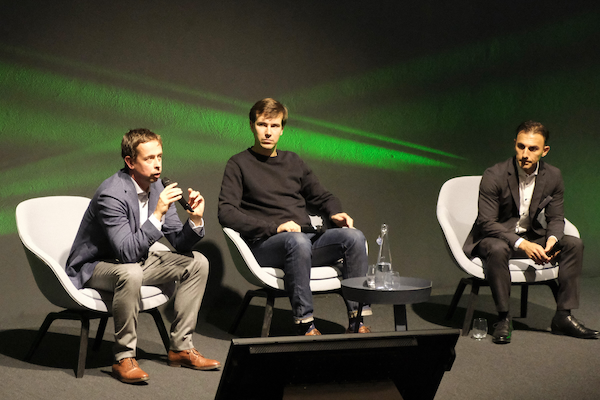
 (L-R) Julien Wolff, Co-founder and Head of Risk Management at 6 Monks; Paul-Adrien Hyppolite, Chief Executive Officer at Spiko; Thomas Campione, CFA Director Strategy, Risk & Transactions at Deloitte;
Credit: Steven Miller, Chronicle.lu
(L-R) Julien Wolff, Co-founder and Head of Risk Management at 6 Monks; Paul-Adrien Hyppolite, Chief Executive Officer at Spiko; Thomas Campione, CFA Director Strategy, Risk & Transactions at Deloitte;
Credit: Steven Miller, Chronicle.lu
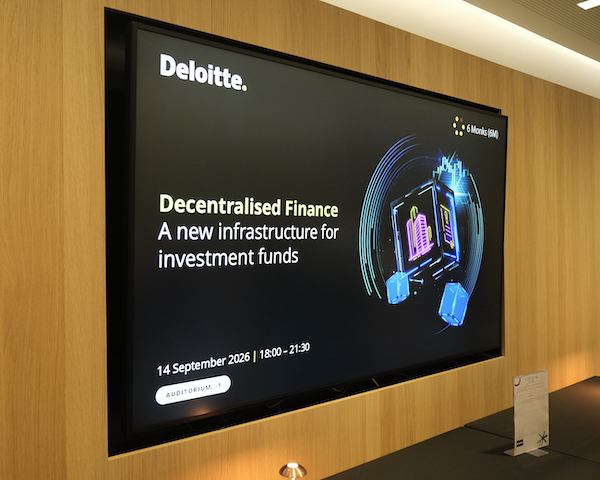
On the evening of Monday 14 September 2026, Deloitte Luxembourg and alternative investment fund manager 6 Monks (6M) hosted an event on decentralised finance (DeFi) at Deloitte’s premises in Luxembourg-Gasperich.
The event welcomed around 100 attendees and featured contributions from Thomas Campione, CFA Director Strategy, Risk & Transactions at Deloitte, Paul-Adrien Hyppolite, Chief Executive Officer at Spiko and Julien Wolff, Co-founder and Head of Risk Management at 6 Monks, and focused on Deloitte and 6 Monks’ white paper on Decentralised Finance (DeFi) as a complementary financial infrastructure rather than a replacement for traditional finance, ahead of its official release on Tuesday 15 September.
DeFi is a financial system built on blockchain technology (a shared digital database or ledger that stores information across a network of computers so it cannot be changed or hacked) which uses smart contracts - self-executing computer programmes on a blockchain - to perform banking and financial tasks automatically, avoiding the need to utilise traditional middlemen such as banks or brokerages.
The event was opened by Thomas Campione, who welcomed the speakers and those in attendance before providing a brief background into the creation of the report and how Deloitte’s work in assessing DeFi coincided with an approach from 6 Monks to produce the white paper collaboratively.
He then detailed the workings of DeFi, the importance of the underlying code in ensuring operational integrity, the transparency afforded by utilising a public blockchain and, ultimately, providing “frictionless accessibility” to investors while ensuring regulatory compliance across all aspects of the system.
On the benefits of tokenisation (the process of replacing sensitive data or real-world assets with unique, non-sensitive digital identifiers), Thomas Campione remarked: “DeFi actually proposes itself as an avenue to create a new playground for frictionless marketing activities. It is all about bringing those assets, making them work continuously and beyond what tokenisation can already offer. So think about a new source of yields, global trading, accessing complex and innovative products and strategies.”
In the context of lending and borrowing, the benefits of DeFi detailed in the report include: the ability to directly borrow available assets up to a loan-to-value threshold; the releasing of funds instantaneously; positions are automatically liquidated if the loan-to-value threshold is reached; fast-track approval process; enhanced liquidity through faster withdrawals.
Paul-Adrien Hyppolite detailed Spiko’s position as a tokenisation platform and described how its users can borrow stablecoins (digital currencies designed to keep a steady value by linking them to real-world assets like the US dollar) using fund shares, unlocking their liquidity and making them available for investment into crypto assets, and allowing them to be used as collateral.
In relation to DeFi, he remarked: “DeFi is a new source of liquidity, a new source of yield, but most importantly, a new infrastructure, a new paradigm, to potentially end up [with] 24-7 access to your cash and to get pro-value continuous 24-7 yield and call.”
Julien Wolff went on to describe the operating model for DeFi and how the system can be tailored for investment fund managers through bespoke frameworks in terms of governance, security, etc.
There then followed a Q&A session with Thomas Campione, Paul-Adrien Hyppolite and Julien Wolff answering questions from the audience on DeFi in relation to risk, privacy, capital market structure, yields, protocols and licensing.
The event concluded with a networking session with food and refreshments supplied by the hosts.
Credit: Steven Miller, Chronicle.lu