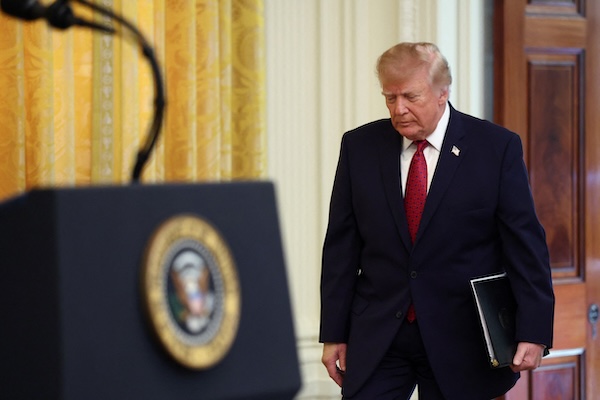
 US President Donald Trump attends a Hispanic Heritage Month reception in the East Room at the White House in Washington, DC, US, 30 September 2026;
Credit: REUTERS/Kevin Lamarque
US President Donald Trump attends a Hispanic Heritage Month reception in the East Room at the White House in Washington, DC, US, 30 September 2026;
Credit: REUTERS/Kevin Lamarque
WASHINGTON (Reuters) - US President Donald Trump unveiled plans on Wednesday 30 September 2026 for South Korea to invest some €176 billion in US projects, but Seoul quickly suggested one key element, a €48 billion pipeline for an LNG project in Alaska, was not yet set in stone.
The announcement from the White House amounted to the first set of major projects under a broader €308 billion strategic investment package South Korea made as part of a trade agreement with Washington last year. The package included €132 billion for shipbuilding and €176 billion for strategic investments.
“Thanks to the agreements my administration has secured with the Republic of Korea, they will invest up to €176 billion,” Trump said from the Oval Office.
He said the investment would include the construction of eight large-scale nuclear power plants, a natural gas pipeline and a six-gigawatt power generation facility in Texas.
The announcement is the latest in a series of economic and investment deals Trump is highlighting ahead of November's 2026 midterm elections, as he seeks to reinforce his economic record amid voter concerns over the Iran war and high gasoline prices.
The pipeline project could carry political significance in Alaska, where Republican Senator Dan Sullivan faces a competitive re-election race against Democrat Mary Peltola. Sullivan attended Wednesday's announcement.
South Korea's government, however, said the pipeline project would only go forward if certain commercial and legal conditions are met. Seoul confirmed other elements of Trump's announcement, saying it would invest €19.6 billion in a Texas gas power project to power AI data centres, as well as €106 billion to build eight nuclear reactors.
Project long in limbo
South Korea will begin reviewing the Alaska LNG project to assess its commercial viability and compliance with legal procedures, Seoul's industry ministry said in a statement.
“No decision has been made on whether to invest or on the size of the investment,” it said.
South Korean President Lee Jae Myung also said in a post on X that the commercial viability of both the LNG project and the nuclear reactors must be confirmed before they proceed.
Any differences between Seoul and Washington over details of the deal could lead to disputes between the allies over its implementation, analysts in Seoul said.
The Alaska LNG project, if it ultimately goes forward, includes a 1,299-km pipeline carrying natural gas from the North Slope to a liquefaction facility on Alaska's southern coast, allowing the fuel to be shipped to Asian markets. The project is designed to transport about 110 million cubic metres of natural gas per day and produce up to 20 million tonnes of LNG annually, according to the White House.
Trump has repeatedly promoted the project as a way to expand US energy exports and strengthen ties with allies including South Korea and Japan.
But the project has faced years of uncertainty over its cost, financing and commercial viability.
South Korea's industry ministry said last week that a more than six-gigawatt gas-fired power plant in Encinal, Texas, was the first project selected under the €176 billion strategic investment programme.
Commitments need to be binding
Japan's two biggest LNG importers, JERA and Tokyo Gas, have signed preliminary agreements to buy a combined 2 million tonnes a year from Alaska LNG if it is built.
Glenfarne, the project's developer, welcomed Trump's investment announcement. It has lined up commitments for 13 million tonnes a year, but needs another 3 million tonnes to support a final investment decision and make commitments binding.
“Glenfarne will work with the US and Korean governments to finalise the investment structure and complete the remaining steps required to reach FID,” it said in a statement.
The eight nuclear plants would form part of Trump's effort to expand US nuclear generation as electricity demand rises, including from data centres and manufacturing. South Korea has been discussing a potential investment in US nuclear projects as part of the broader package.
The Texas gas-fired power project is expected to supply electricity to energy-intensive facilities, including semiconductor plants and data centres. South Korean officials have said the project was selected after reviews of its commercial viability.