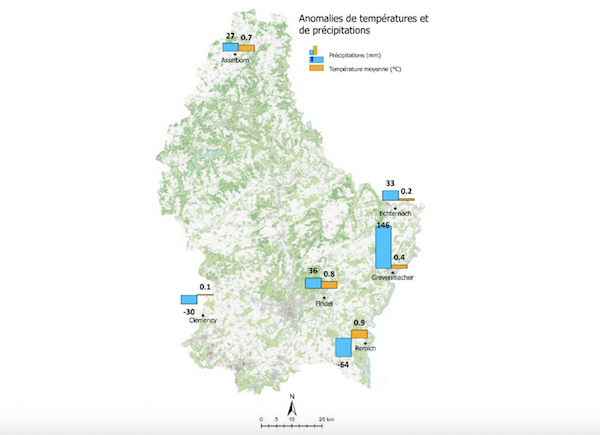
 Anomalies in air temperature and precipitation at various locations in Luxembourg, compared with the climatic normal (1991–2020);
Credit: ASTA & MeteoLux
Anomalies in air temperature and precipitation at various locations in Luxembourg, compared with the climatic normal (1991–2020);
Credit: ASTA & MeteoLux
On Friday 2 January 2026, Luxembourg’s Ministry of Agriculture, Food and Viticulture together with MeteoLux and AgriMeteo, published their end-of-year assessments, showing that 2025 was warmer than average in Luxembourg.
Temperatures
According to the data, the annual temperatures in 2025 exceeded the 1991-2020 climate reference period, with anomalies ranging between +0.1 and +0.9 °C with most months of the year recorded above-average temperatures. At Remich and Findel, July was the only month below the climatic norm. At Asselborn, January, February and July were cooler than average, while Clemency recorded below-average temperatures in May, July, August, September and November. June showed the strongest positive temperature anomaly of the year, while July recorded the most pronounced negative anomaly.
Precipitation
Rainfall levels in 2025 varied considerably depending on the region. Annual rainfall totals were above the reference period at Asselborn and Findel but below normal at Clemency and Remich. All weather stations recorded rainfall deficits during seven months of the year. At Asselborn, Findel and Remich, deficits occurred in February, March, May, June, August, November and December. At Clemency, rainfall deficits were observed from February to May, as well as in August, November and December.
September recorded the most significant rainfall surplus of the year, with historical records measured at several stations. Clemency recorded a surplus of +211.6 mm, Remich +157.1 mm and Findel +265.1 mm. In contrast, December showed the most pronounced negative precipitation anomaly.
Flooding
The weather conditions also resulted in flooding during the year. At the beginning of January, heavy rainfall combined with rapid snowmelt caused local flooding along the Alzette, Sûre and Moselle rivers. In September, intense rainfall again led to flooding in the Alzette valley, notably in Pfaffenthal and Steinsel.
According to the ministry, despite strongly contrasting weather conditions, 2025 was generally favourable for agriculture, with a balance between rainfall and moderate temperatures contributing to good yields across forage crops, cereals, potatoes, fruit and vegetables. Viticulture also recorded a good year: spring was dry and the season progressed under favourable conditions up to the harvest. In September, heavy rainfall made harvesting conditions more difficult, requiring winegrowers to select grapes very carefully; despite this, the 2025 harvest recorded positive results.
EO