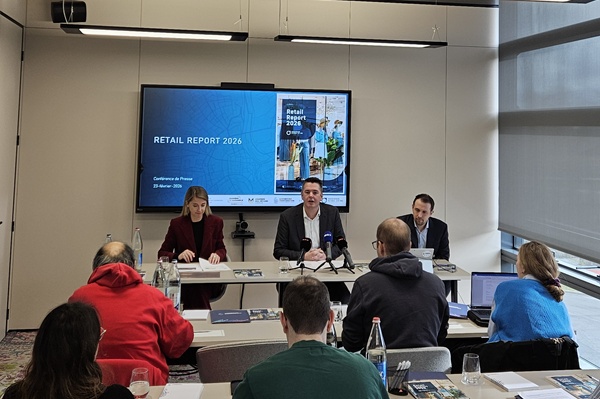
 (L-R) Stéphanie Damgé, Director of Entrepreneurship at Luxembourg Chamber of Commerce; Lex Delles, Luxembourg's Minister of the Economy, SMEs, Energy and Tourism; Tom Baumert, President of GIE Observatoire National des PME, CEO of Luxembourg Confederation;
Credit: Jazmin Campbell, Chronicle.lu
(L-R) Stéphanie Damgé, Director of Entrepreneurship at Luxembourg Chamber of Commerce; Lex Delles, Luxembourg's Minister of the Economy, SMEs, Energy and Tourism; Tom Baumert, President of GIE Observatoire National des PME, CEO of Luxembourg Confederation;
Credit: Jazmin Campbell, Chronicle.lu
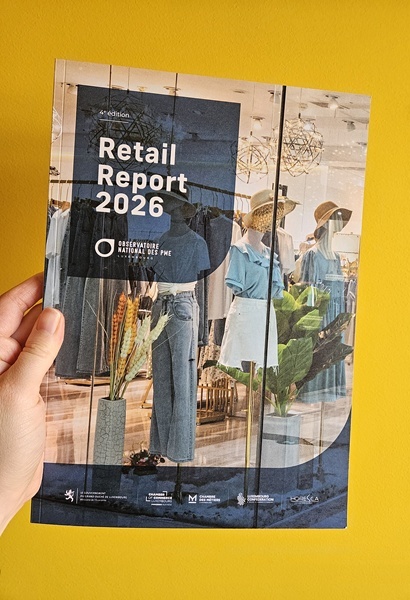
On Monday 23 February 2026, Luxembourg's Minister of the Economy, SMEs, Energy and Tourism, Lex Delles, together with Tom Baumert, President of the National SME Observatory and CEO of Luxembourg Confederation, and Stéphanie Damgé, Director of Entrepreneurship at the Luxembourg Chamber of Commerce, presented the fourth edition of Luxembourg's "Retail Report" at a press conference.
Established in 2022 as part of the "Pakt Pro Commerce", the report serves as a strategic tool for observing and analysing national trends in retail trade, helping to guide evidence-based public policy. It also provides insights into related sectors, including hospitality (Horeca).
Speaking in Luxembourgish, Minister Delles delivered a general introduction and presented the main elements of the Retail Report 2026, after which Tom Baumert elaborated on the key findings and Stéphanie Damgé presented the results of the Luxembourg Chamber of Commerce's Economic Barometer.
One of the report's key findings was a continued decline in retail space per capita. By the end of the third quarter of 2025, total retail space in Luxembourg amounted to nearly 1.09 million m². However, due to population growth of 10% since 2019 and the expansion of online commerce, retail space per capita has fallen to 1.58 m² - its lowest level since data collection began. Over the past twelve months, growth in the number of retail businesses (+1.1%) and hospitality establishments (+3.4%) remained below the pace of population growth.
Moreover, the report highlights contrasting sectoral developments. The food retail sector continued to show the strongest performance, with 110 new outlets since 2019 (+18.9%) and retail space expanding by 12%. Hard-discount stores recorded particularly strong growth (+39.4% retail space), while stores specialising in international food products also increased significantly (+31.1%), reflecting the country's demographic and cultural evolution.
In contrast, other retail sectors have experienced more moderate growth or even a decline. The fashion and beauty category saw a 12% decrease in outlets since 2019, while retail space dedicated to home furnishings fell by 6.7%. Electronics retailers were also among the sectors experiencing a downturn.
Within the Horeca sector, the number of fast-food establishments has increased by 43% since 2019, reaching 389. Conversely, bars, cafés and bistros saw a decline of approximately 9.2% over the same period.
While overall commercial activity in city centres has stabilised over the past year, the report highlights a clear structural shift. Between 2019 and the end of 2025, the share of traditional retail in city centres dropped from 37.5% to 32.2%, reflecting diversification towards services and hospitality. Commercial vacancy rates in city centres fell to 13.3% by the end of 2025 - their lowest level in four years - although they remained higher than in shopping centres, where vacancy stood at 5.3%.
In this context, the development of flexible concepts such as pop-up stores - the number of which has more than doubled since 2019 - as well as more coordinated management of retail space, are considered important levers for strengthening the attractiveness and multifunctionality of urban centres.
Minister Delles noted that the Retail Report 2026 "confirms that retail is evolving in a rapidly changing environment," adding that "these transformations call for a continuous adaptation of our policy framework." He emphasised the importance of targeted support for small and medium-sized enterprises (SMEs), "particularly through initiatives aimed at accelerating digitalisation and the adoption of artificial intelligence", and noted plans to strengthen the "Cadastre de Commerce", extending it beyond city centres to activity zones.
Speaking to Chronicle.lu about the main trends and support offered by his ministry, Minister Delles described artificial intelligence (AI), digitalisation and cybersecurity as "major topics". He stated: "First of all, we see that digitalisation is always a big issue. That's why we put in place 'SME Packages'," a support programme that helps businesses with activity development, digital transformation, continuous training and administrative simplification.
"We see with this retail report, that we have less empty spaces - the lowest level since 2019 in Luxembourg. Compared to the international benchmark, we are very low. We see that we have activity in different retail sectors, much more in Horeca, for example restaurants and cafes. But it's also part of the diversification of city centres. Today, if you go to a city centre, you want also restaurant[s], you want a bar, not only shops. That's a structural change that we see in this retail report," he continued, also highlighting "a huge increase" in grocery shops, but fewer clothes shops in Luxembourg. "So, we see that we have a shift in retail commercial activities," he said.
Tom Baumert added that the Retail Report is "a key resource for understanding the evolution of retail in Luxembourg. It offers structured analyses and essential strategic insights to guide future actions in the sector. Complementing the 'cadastre de commerce', it provides precise data on the evolution of the retail landscape, regional dynamics, consumer trends and ongoing structural transformations. Together, these tools provide a solid factual basis for informing decision-making, strengthening the competitiveness of Luxembourg's retail sector and supporting its transition in the face of economic challenges".
He also higlighted the Localyze.lu platform, which provides data-driven location analysis tools for retail and craft businesses, Horeca, services, institutions and the press. To date, 268 businesses have registered on the platform.
Stéphanie Damgé presented findings from the Luxembourg Chamber of Commerce's Economic Barometer survey for the second half of 2025. The results indicate a generally stable outlook, although growth has stalled in recent years. Company directors expressed confidence in their own businesses and resilience, while consumers remained more cautious. Investments tend to focus on modernisation, renewal of equipment and digitalisation, while key challenges were linked to the workforce. Stéphanie Damgé said both the Retail Report and the Economic Barometer results "show that Luxembourg retailers are demonstrating resilience in moving forward despite economic uncertainties. They are adapting their models, investing and evolving their practices to remain attractive and competitive." She also underscored the need to continue supporting SMEs through these transitions.
The Retail Report 2026 is available online at https://retailreport.eco.etat.lu/