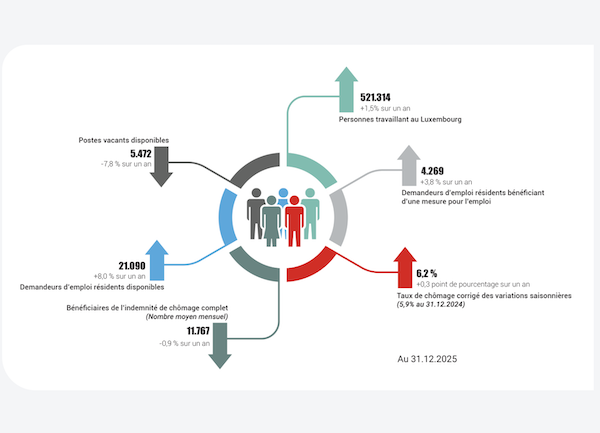
 ADEM infographic showing Luxembourg labour market indicators as of 31 December 2025;
Credit: ADEM
ADEM infographic showing Luxembourg labour market indicators as of 31 December 2025;
Credit: ADEM
On Wednesday 13 May 2026, Luxembourg employment agency ADEM presented its annual report for 2025, revealing that more than 21,000 resident jobseekers were registered at the end of 2025, while the unemployment rate reached 6.3% in March 2026.
During a press conference held in the presence of Luxembourg’s Minister of Labour, Marc Spautz, ADEM Director Isabelle Schlesser outlined the main labour market trends and the continuing structural challenges facing Luxembourg’s economy. According to ADEM, the number of registered resident jobseekers reached a record level at the end of 2025, significantly impacting the agency’s activity.
Despite a slight increase in job vacancies, ADEM noted that the sharp rise in the number of jobseekers continues to place the labour market under pressure, reflecting what it described as an unprecedented situation in recent decades amid ongoing economic transformation.
While the unemployment rate stood at 6.2% at the end of December 2025, Minister Spautz stressed that “domestic employment continued to grow last year, with the creation of 6,000 new jobs, demonstrating the resilience of our model”.
ADEM reported that more than 42,000 people registered with the agency during 2025, representing an increase of 26% since 2022. This figure included more than 9,000 non-resident jobseekers, up 70% compared to 2022.
In 2025, 26,125 people received full unemployment benefits, marking a 33% increase compared to 2022. A total of €455 million in unemployment benefits was paid out, including an increase of €30 million over one year and €130 million over two years.
The agency also noted that nearly 13,000 employees were supported through unemployment prevention schemes, with €42 million paid to almost 1,000 employers. In addition, more than 123,000 job referrals were sent to jobseekers during the year, while 1,159 people entered adult apprenticeship contracts.
Minister Spautz stressed that “faced with developments in the labour market reflecting structural challenges that require ambitious, coordinated and sustainable responses, the role of ADEM is more central than ever.”
According to ADEM, training, reskilling and professional integration remain key priorities in order to address labour market changes and future skills needs, alongside growing attention to the impact of new technologies and artificial intelligence.
The employment agency also highlighted strengthened cooperation with employers through the “Entreprise, partenaire pour l’emploi” label, launched as part of a strategic partnership with the Luxembourg Employers' Association (Union des Entreprises Luxembourgeoises - UEL). While the first ten companies signed commitments supporting professional integration in 2025, a total of 24 companies have now received the label.
ADEM further noted that the implementation of the Skills-Plang initiative, designed to support job retention, and the launch of the new Work in Luxembourg portal for sectors facing labour shortages, have expanded the range of measures available to employers.
Addressing the agency’s digitalisation strategy, Isabelle Schlesser stated: “The digitalisation of service offerings and our internal procedures is a key lever in responding to increased activity volumes. For autonomous users, it provides speed, efficiency and flexibility.” However, she stressed that digitalisation could not become the sole access point to ADEM services, adding: “Individual and personalised support will always remain available to jobseekers who need it.”
ADEM reported that a major step in this process was the launch, on 10 November 2025, of the online application system for full unemployment benefits via MyGuichet.lu. According to the agency, 85% of unemployment claims are now submitted online independently.
“We are engaged in a profound transformation and, for the vast majority of jobseekers, this digitalisation has been very well received, since 85% of unemployment claims are now submitted online independently,” Isabelle Schlesser said. She added: “The digitalisation roadmap will guide our future actions and contribute to ADEM’s future strategy towards 2030.”
Looking ahead to 2026, ADEM identified three major projects.
The first concerns a new law supporting youth employment, set to enter into force on 1 July 2026. The legislation will open professionalisation internships to people under 30 and simplify the management of employment support measures by making ADEM the formal employer of beneficiaries, while companies reimburse a fixed amount.
Secondly, ADEM plans to introduce new digital services for both jobseekers and employers. By the end of 2026, the registration procedure via MyGuichet.lu is expected to become faster and more intuitive. According to ADEM, 35% of jobseekers already register digitally and this share continues to increase. The declaration of job vacancies via MyGuichet will also be simplified, with nearly half of all vacancies already submitted through digital channels.
The third major project relates to the future management of cross-border jobseekers, in anticipation of potential changes to Regulation (EC) No 883/2004 concerning unemployment arrangements for cross-border workers.
“An adaptation of practices will be necessary, with increased digitalisation needs in order to ensure efficient processing of the growing number of jobseekers,” explained Isabelle Schlesser.
During the presentation, Minister Spautz and Isabelle Schlesser also highlighted the work of ADEM’s more than 700 employees, praising their professionalism, adaptability and commitment to public service during a period of increased activity and structural transformation.
The full 2025 annual report is available on ADEM’s website.