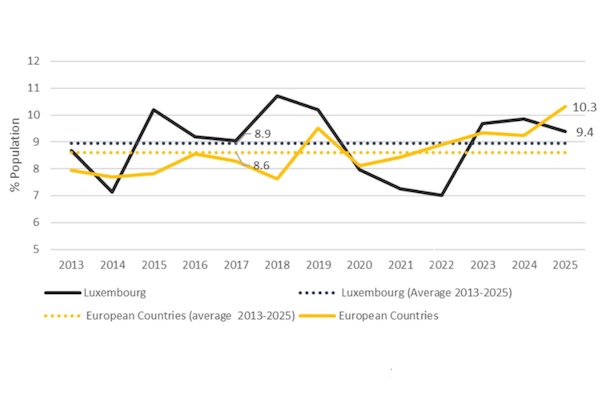
 Total early-stage entrepreneurial activity rate (% of the population);
Credit: Rapport GEM 2025-2026
Total early-stage entrepreneurial activity rate (% of the population);
Credit: Rapport GEM 2025-2026
On Thursday 2 July 2026, Luxembourg's national statistical office STATEC, released the Global Entrepreneurship Monitor (GEM) Luxembourg 2025/2026, showing that entrepreneurial activity remained broadly stable despite growing global economic uncertainty.
According to the report, the share of residents actively involved in starting or running a new business fell slightly from 9.9% in 2024 to 9.4% in 2025. Nevertheless, entrepreneurial intentions in Luxembourg remain among the highest in Europe, while fear of failure continues to be relatively low. Among respondents who identified good business opportunities, 42% said fear of failure discouraged them from starting a business.
STATEC noted that 36% of early-stage entrepreneurs expect weaker business growth, representing one of the highest proportions among the countries covered by the survey.
The report also highlighted the continued importance of artificial intelligence (AI) for Luxembourg's entrepreneurs. Around 32% of early-stage entrepreneurs consider AI to be very important to their business model and strategy, slightly above the European average of 30%. However, optimism about AI has declined, with only 24% expecting it to have a strong positive effect on business growth, compared with 47% previously. At the same time, 45% of early-stage entrepreneurs (TEA) reported concerns relating to data security and privacy, down from a previous high of 58%.
Entrepreneurs also continued to demonstrate a commitment to sustainability, although the report noted a decline in both social and environmental initiatives compared with 2024. The proportion of early-stage entrepreneurs implementing measures to maximise their social impact fell from 56% to 45%, while those taking steps to minimise their environmental impact declined from 61% to 53%. Despite this, both figures remain above the European average (44.6% and 52.1% respectively).
The report shows that the access to finance emerged as one of the main obstacles facing entrepreneurs. More than half (52%) of early-stage entrepreneurs reported difficulties obtaining funding, placing access to finance alongside the cost of business premises (57%) and the availability of skilled labour (48%) as the most significant barriers to starting a business. The report also found that entrepreneurs continue to rely primarily on personal savings, followed by financial support from family and friends, while formal external financing plays a relatively limited role during the early stages of business creation.
For the first time, the GEM Luxembourg report also examined the impact of international trade and migration policies on entrepreneurs' expectations. According to the survey, 40% of early-stage entrepreneurs expect production costs to increase as a result of recent international developments, while only 20% anticipate an improvement. Entrepreneurs whose businesses depend on markets outside the European Union (EU) expressed the greatest level of concern.
The report also showed that necessity-driven entrepreneurship remains below the European average, with 36% of Luxembourg entrepreneurs saying they started a business because of a lack of employment opportunities, compared with an EU average of 58%.
While the gender gap in entrepreneurship narrowed in 2025, it persisted, with 7.2% of women engaged in early-stage entrepreneurial activity compared with 11.5% of men. The report also found that immigrants remain more likely than native residents to become entrepreneurs, with 10.5% involved in early-stage entrepreneurial activity, compared with 7.5% of Luxembourg-born residents.