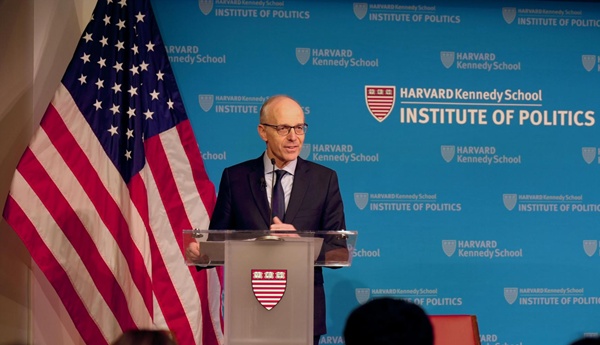
 Luc Frieden, Prime Minister of Luxembourg;
Credit: © ME
Luc Frieden, Prime Minister of Luxembourg;
Credit: © ME
Luxembourg's Prime Minister Luc Frieden delivered a speech at the European Conference at the John F. Kennedy School of Government (Harvard Kennedy School) at Harvard University (Institute of Politics) in the United States (US) on Friday 6 February 2026.
In his speech, Prime Minister Frieden, a Harvard Law School alumnus, spoke of "the European way", inviting the audience to "come and see" a continent often portrayed as being in decline.
He painted a vivid picture for the audience, describing education as a right rather than a privilege in Europe and highlighting advantages such as visa-free mobility. "This is not a utopia, nor a distant dream or idealised vision. This is Europe," he said. He addressed the misconception of Europe as "a continent in decline", often framed as being in crisis, and invited the public to "come and see" what Europe has to offer: dynamic yet compassionate societies rooted in solidarity, ambitious yet responsible innovation, and economies that "pursue growth, while respecting social and ecological limits".
"Because where others describe a continent in constant decline, I see continuous progress," Prime Minister Frieden said, adding: "Crisis has never been Europe's weakness. It has been its engine. A catalyst - for change, for progress". He referred, among other examples, to the two World Wars, which led to the emergence of "the unique European peace project".
"We are now living through another period of historical significance, standing at yet another crossroads," Prime Minister Frieden continued, commenting on historic and current transatlantic relations. He quoted former US President John F. Kennedy, who said that "the free nations of Europe are moving towards a unity of purpose and power and policy in every sphere of activity. We regard her as a welcome partner, not a rival". Prime Minister Frieden described these words as "strikingly current" today, noting that Europe's strength has always come from "choosing cooperation over fragmentation, shared purpose over short-term advantage, and responsibility over retreat".
"Today, we are faced with a structural rupture in that relationship. But where others see this as the end of Europe, I see it as our moment to seize," he said, adding that this could be achieved by "sticking to the same values and principles that have guided us through past periods of change: democracy, stability, freedom".
The prime minister stressed that Europe does not claim to be perfect. "We discuss, we negotiate, we compromise," he said, acknowledging that the process may seem slow. "But there is a reason for this approach: a political culture shaped by a collective memory, cautious of simplistic answers and mindful of consequences". He highlighted Europe's post-Second World War ability "to manage disagreement without violence, to transform difference into dialogue," noting that compromise is "encouraged, not shunned".
"Come and see," he reiterated, emphasising the need for "honest solutions" to complex challenges. "Yes, we want technological progress, but it must serve humanity. Yes, we want economic growth, but it must respect planetary limits. Yes, we want security, but not at the expense of freedom, trust and social cohesion," he said. While negotiation takes time, he noted that Europe's decisions are "lasting" and "predictable". In this context, he underlined Europe's soft power, stating that "in a fragmented world, this soft power may be the most powerful of all".
He added that "Europe measures power differently. Not just by what wins, but by what holds," emphasising the value of partnerships.
Prime Minister Frieden also acknowledged the complexity of freedom, noting that freedoms "may be absolute for every individual. But, within a society, they must be contingent on respecting the freedoms of those with whom we live". He said that this European understanding of freedom is "rooted in history", adding that freedom of expression is protected "because Europeans know, from experience, what happens when it disappears." He underlined the importance of education in this context.
Turning to the future of European integration, Prime Minister Frieden identified three key areas: the economy, energy and defence. "Our top priority must be our economic success. Because it is the basis for our welfare, and it generates the wealth to deal with all other challenges," he said. He highlighted the EU's "many economic strengths" and its reliability and predictability in an uncertain world. He stated: "Europeans dared. And Europeans succeeded. I want us to dare again. Because I want us to succeed again."
The prime minister described energy as "the fundamental driver of economies", adding that, in times of uncertainty, it is "a question of sovereignty". He stressed the need for Europe to expand its own energy production and "build a truly European energy market where power flows freely across borders", while noting Europe's efforts to align economic growth with environmental responsibility.
On defence, Prime Minister Frieden underlined the need for Europe to build up its defence capacity, "not to intimidate our neighbours, but to deter potential aggressors." He described Russia's "unjustified invasion" of Ukraine as "a wake-up call" for Europe and said that a wide-ranging discussion on future of NATO is "inevitable": He said this was a matter of "making a conscious choice on reducing our dependency and establishing a balanced relationship" with the United States, also highlighting the "need to reconsider the idea of a European army" - "not for the immediate future", he said, but added that "dismissing it out of hand would be a mistake too".
Summing up "the European way", the prime minister said that Europe's leadership in a changing world "will not be defined by domination, but by demonstration", choosing "cooperation over isolation, law over force, dialogue over division - not because it is easy, but because it works."
"Crises do not only destroy. They reveal. They show what is essential, what endures, and who we are," he said, offering a renewed invitation: "So, to those who are skeptical about Europe's future, I offer not an argument, but an invitation: come and see... Come and see European cities built for people, not cars... European universities where ideas matter more than backgrounds... European energy networks being revamped from fossil fuels to renewable sources... European societies that invest not only in markets, but in meaning."
Prime Minister Frieden concluded: "The question is not whether Europe will endure. The question is what more Europe can show the world. Come and see."