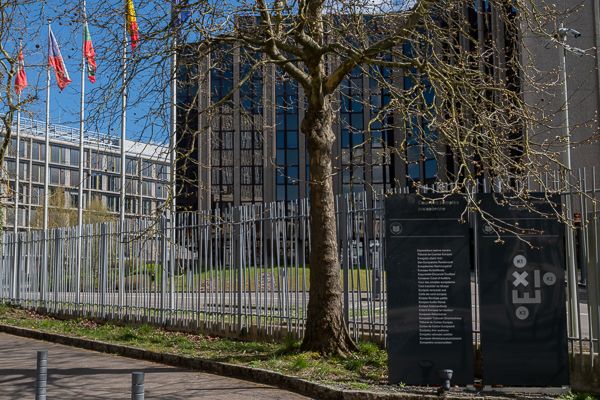
 European Court of Auditors in Luxembourg-Kirchberg;
Credit: Ali Sahib, Chronicle.lu
European Court of Auditors in Luxembourg-Kirchberg;
Credit: Ali Sahib, Chronicle.lu
Chronicle.lu has compiled a new series of articles dedicated to European institutions, bodies and agencies with a presence in Luxembourg.
Standing alongside Brussels in Belgium and Strasbourg in France, Luxembourg City is one of the European Union's three official seats. A founding member of the European Union (EU), Luxembourg is known internationally as a business and financial hub and hosts several major EU institutions and other bodies.
Based mainly in Luxembourg-Kirchberg, these institutions shape European law, finance and democratic processes and employ around 15,000 international professionals.
Throughout this series, Chronicle.lu will introduce the main European institutions, bodies and agencies in Luxembourg and explain how they work. This article focuses on the European Court of Auditors.
The European Court of Auditors (ECA) is the supreme audit institution (SAI) of the European Union and acts as the independent external auditor of the EU, with its primary purpose to ensure that EU funds are properly collected, spent legally and used effectively.
Established in 1975 in Luxembourg, the ECA comprises one member from each of the EU's 27 member states. It is located in Luxembourg-Kirchberg and supported by approximately 800 civil servants.
The ECA was not originally a formal institution but acted as an external body designed to audit the finances of the European Communities. Its establishment replaced two separate audit bodies, one which dealt with the finances of the European Economic Community (EEC) and Euratom and one which dealt with the European Coal and Steel Community (ECSC).
The ECA was eventually established as an official EU institution under the Treaty of Maastricht in 1992, becoming the fifth official institution of the EU and gaining powers, such as the ability to bring actions before the European Court of Justice (ECJ). Under the Treaty of Amsterdam, signed on 2 October 1997, it gained the full power to audit the finances of the whole of the EU.
Structurally, the ECA consists of five audit chambers, overseen by the Presidency and administered by the Secretariat General. Under this structure reside four committees related to quality control, administration, ethics and internal auditing.
Structure of the ECA:
- Presidency: Corporate strategy; Institutional liaison; Communication; Legal matters; Internal audit
- Secretary General: Court Secretariat; Human resources, finance and general services; Information, workplace and innovation; Language and editorial services; Data protection; Information security
- Chamber I: Sustainable use of natural resources
- Chamber II: Investment for cohesion, growth and inclusion
- Chamber III: External action, security and justice
- Chamber IV: Regulation of markets and competitive economy
- Chamber V: Financing and administering the Union
- Audit Quality Control Committee
- Administrative Committee
- Ethics Committee
- Internal Audit Committee
The current President of the ECA is Tony Murphy (Ireland), who took office in October 2022. The president is elected by ECA members on a renewable three-year term and their responsibilities include convening and chairing the meetings of the ECA, ensuring that decisions are implemented and that departments are appropriately managed. The president also represents the institution and appoints a representative for it in contentious proceedings. Luxembourg's Marcel Mart held the position of ECA president from October 1984 to December 1989.
The current Secretary General of the ECA is Zacharias Kolias (Greece), who assumed the position in January 2021. The secretary general is appointed for a renewable term of six years and is responsible for the management of the ECA's staff and for the administration of the ECA, as well as the ECA's budget.
Luxembourg's current representative for the ECA is Joëlle Elvinger, a lawyer and member of Luxembourg’s Democratic Party and serves in ECA Chamber I. She was nominated by the Luxembourg Government in November 2019 as the replacement for Henri Grethen, who had held the position since 2008.
The ECA helps other EU institutions and the Member States to better manage and supervise the use of EU funds and assists the European Parliament when deciding whether the EU's accounts for the previous year are accurate and the funds were properly spent, a process known as "granting discharge".
The ECA also produces authoritative audit reports to assist in how the EU uses its money and implements its policies.
These reports are available to the public. However, to protect the professional relationship between auditor and auditee, supporting documents and audit evidence remain confidential. Audit reports and opinions are published in each of the official EU languages.
As the EU's external auditor, the ECA does not have a mandate to investigate cases of suspected fraud against the EU's financial interests. Where any illegal activity is suspected, the ECA reports it to the European Anti-Fraud Office (OLAF) and the Commission department responsible for investigating suspected cases of fraud and corruption in depth.
SM/JCA