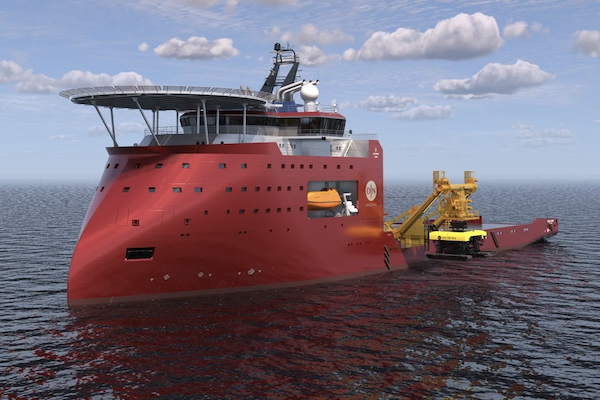
 A digital rendering of a Trenching Support Vessel;
Credit: Jan De Nul
A digital rendering of a Trenching Support Vessel;
Credit: Jan De Nul
On Tuesday 10 March 2026, Jan De Nul, a civil engineering company with its financial headquarters in Luxembourg announced its continued investment in its subsea power cable fleet.
In a press release, Jan De Nul said it had ordered a new vessel to bury subsea power cables in the seabed and a second vessel is currently being modified to bury power cables in shallow waters. Subsea cables are deemed a crucial element for exporting energy produced at sea. They are also seen as an essential link in connecting local and national electricity grids.
Jan De Nul noted that energy independence is a global priority and the company is actively expanding its fleet dedicated to offshore energy to address this challenge. Two large vessels intended for the installation of subsea cables are currently under construction. Last year, the company also announced the order of a rock installation vessel to protect these cables.
According to the company, the first new addition to its fleet will be a new trenching support vessel equipped with a state-of-the-art subsea robot. Controlled from the bridge, the robot can bury cables to a depth of up to five metres. It will be built at the CMHI shipyard in China.
Jan De Nul will also convert its existing vessel Henry Darcy into a trenching support vessel. It will be equipped with a subsea robot specialised in burying cables in shallow waters.
Wouter Vermeersch, Director Subsea Cables Offshore Energy at Jan De Nul, said: “With the Fleeming Jenkin and William Thomson, we will soon strengthen our fleet with two XL vessels designed for subsea cable installation. Investing in vessels capable of protecting these same cables is a logical next step. Last year, we announced the rock installation vessel George W. Goethals, which protects cables and other energy infrastructure with a protective layer of rocks. We are now expanding our fleet with vessels designed to safely bury cables in the seabed.”