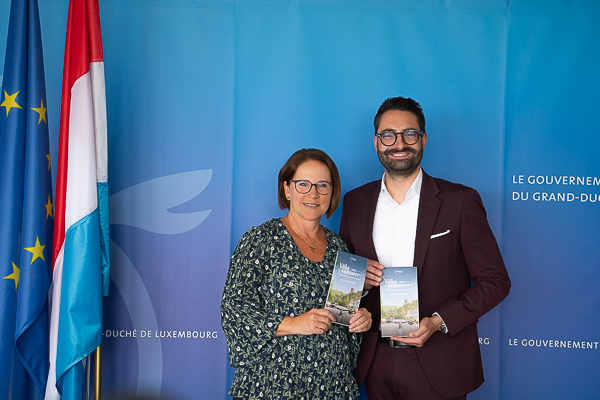
 (L-R) Yuriko Backes, Luxembourg's Minister for Mobility and Public Works; Eric Thill, Luxembourg's Minister Delegate for Tourism;
Credit: Ali Sahib, Chronicle.lu
(L-R) Yuriko Backes, Luxembourg's Minister for Mobility and Public Works; Eric Thill, Luxembourg's Minister Delegate for Tourism;
Credit: Ali Sahib, Chronicle.lu
Luxembourg's Ministry of the Economy and the Ministry of Mobility and Public Works have confirmed that the seventh edition of the Vëlosummer cycling initiative will take place across the Grand Duchy from Saturday 18 July to Sunday 16 August 2026.
At a press conference held on World Bicycle Day on Wednesday 3 June 2026, Luxembourg's Minister for Mobility and Public Works, Yuriko Backes, and Minister Delegate for Tourism, Eric Thill, presented the 2026 edition of Vëlosummer, alongside updates on the national cycling network and the rollout of the country's node-point ("Knotenpunktsystem") navigation system.
According to the ministries, Vëlosummer 2026 builds on the success of last year's edition, which attracted more than 43,000 participants. Organised in cooperation with 52 municipalities and regional tourism offices, the initiative aims to make Luxembourg more accessible by bicycle for both residents and visitors.
This year's programme will feature fourteen routes covering more than 500 kilometres across the country, including 100 kilometres of roads temporarily reserved for cyclists. The organisers have also introduced three new routes, alongside improvements to existing itineraries and the return of several popular circuits from previous editions.
Speaking to Chronicle.lu, Minister Backes said interest in the initiative continues to grow with each edition. "We are now at the seventh edition and we are seeing more and more people who are interested in participating. We are very proud of this initiative where we cover 500 kilometres in Luxembourg and offer fourteen different tours. It's meant for young people, for not so young people, for people living in Luxembourg and also for tourists coming from outside our country," she said.
The official launch of Vëlosummer 2026 will take place on 18 July in Goebelsmühle and will include an opening event followed by a guided ride.
The ministries noted that accessibility and visitor experience have been further enhanced through expanded bicycle rental options, additional activities and events along the routes and the return of the Vëlosummer Challenge via the VisitLuxembourg app. Participants will be able to check in at fourteen locations and complete a quiz for a chance to win the 2026 edition of the symbolic yellow jersey.
Minister Thill described Vëlosummer as an important tool for promoting Luxembourg to both visitors and residents. "It is an opportunity to use a bicycle to discover and explore our beautiful country," he said, expressing hope that favourable weather conditions would encourage large numbers of participants to take part in this year's edition.
To help cyclists navigate the routes, the organisers will again distribute the "Vëlosummer in your pocket" map, with 30,000 copies containing route information, difficulty levels and points of interest. Additional information will be available at www.velosummer.lu.
During the press conference, the ministries also highlighted progress on Luxembourg's national cycling network. The Roads Administration has installed nearly 1,900 signs as part of the new node-point system, with more than 600 additional signs currently being deployed.
The system combines traditional directional signage with numbered node points located at key intersections, allowing cyclists to plan personalised routes by following a sequence of numbers. Inspired by similar systems used elsewhere in Europe, the network is expected to expand further in the coming years and eventually comprise around 500 node points nationwide.
Minister Backes noted that cycling has become much more than a leisure activity and is increasingly being used as a means of everyday transport. She added that the government continues to invest in safe, visible and connected cycling infrastructure across the country.
According to the Ministry of Mobility and Public Works, 20 kilometres of new cycle paths entered service between July 2025 and June 2026, while construction began on a further 27.4 kilometres of cycling infrastructure during the same period.
Commissioning planned for July 2026 to June 2027:
- PC2 - between Echternach and Lauterborn (redevelopment of the N11);
- PC3 - Ehnen to Hëttermillen;
- PC6d - Mondorf crossing;
- PC7b - between PC21 and the Clervaux crossroad (lot 2: CR339 cycle path);
- PC17 - between Koetschette and Weissenhaff;
- PC21 - between Maulusmühle and Cinqfontaines, alongside the railway line;
- PC25 - between Useldange and Grosbous (cycle path);
- PC27 - between Pulvermühle and Cents station;
- PC104 - Micheville route cycle link (OA865);
- Bascharage - Schouweiler cycle path (outside the national cycle path network).
Work scheduled to begin between July 2026 and June 2027:
- PC1 - between Bridel and Juegdschlass;
- PC2 - Junglinster crossing;
- PC3 - Dillingen (widening of existing cycle path);
- PC4 - Roodt-sur-Syre crossing;
- PC6 - between Altwies and Mondorf (N16 redevelopment phase);
- PC6 - redevelopment of the CR161/N13 junction between Bettembourg and Hellange;
- PC6 - N13 in Bettembourg between Cité du Soleil and the town entrance;
- PC7 - Fridhaff to Koeppenhaff;
- PC7a - access road to the Lycée Nordstad campus in Erpeldange-sur-Sûre;
- PC20 - between Weidingen and Wiltz;
- PC25 - between Useldange and Grosbous (cycle path);
- PC35 - between Dippach-Gare and Bascharage, alongside CFL railway tracks;
- PC35 - between Dippach-Gare and Gréivelser Barrière;
- PC37a - between the Alzette and Bettembourg;
- PC104 - Micheville route cycle link (OA865);
- cycle path alongside the CR158 between Roeser and Boevange;
- cycle path alongside the B7 in Schieren.