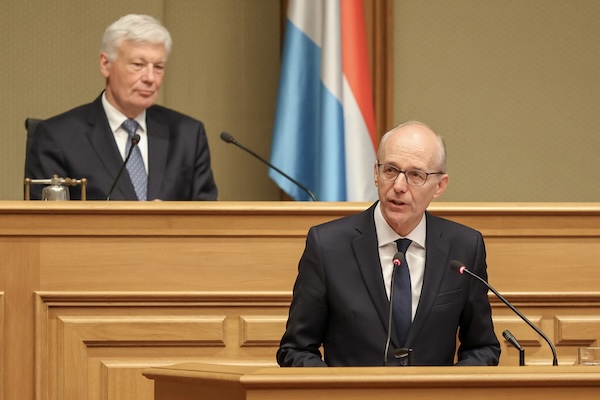
 (L-R) Claude Wiseler, President of the Chamber of Deputies of Luxembourg; Luc Frieden, Luxembourg Prime Minister;
Credit: SIP / Julien Warnand
(L-R) Claude Wiseler, President of the Chamber of Deputies of Luxembourg; Luc Frieden, Luxembourg Prime Minister;
Credit: SIP / Julien Warnand
On the afternoon of Tuesday 19 May 2026, Luxembourg’s Prime Minister Luc Frieden delivered his State of the Nation address in the Chamber of Deputies (parliament), with an emphasis on building “a country that stands together, lives together, grows together and where future generations can grow up together”.
He began his speech by emphasising that social cohesion is “the most precious asset of our nation”, especially at a time when the world is being shaped by wars, populism, new technologies, as well as economic and social challenges.
Prime Minister Frieden said: “We are living through a period of deep changes that will shape the decades to come. But even as international cooperation is weakening, the consequences of what is happening in the world do not stop at national borders. That is why Luxembourg will remain fully committed in favour of multilateral institutions and international law – alongside our neighbours, within the European Union, NATO and the United Nations.”
The Prime Minister stressed that with several wars “in our immediate neighbourhood” – in Ukraine, in Gaza and in Iran - and a growing tendency for fundamental principles to be called into question, the response for Luxembourg must lie in a stronger European Union. He said: “The EU is the answer to internal tensions, because it embodies our values and remains the best means of defending them in the future. We want more Europe, because we want to protect our democracy, our freedom and the rule of law. The EU is also our best response to global turmoil, because it enables us to become more independent of what is happening in the world – in energy, security, technology, space and food production.”
Economic outlook
In relation to the ongoing issues caused by the closure of the Strait of Hormuz, Prime Minister Frieden highlighted that this situation reminds the country how dependent it is, a position seen at the country’s at petrol stations, along with the rising cost of fertilisers, food products and other goods. He referenced a forecast by the experts at the International Monetary Fund and the European Central bank which stressed “economic and social consequences are probably still ahead of us” and emphasised that Luxembourg is no exception to this.
Government priorities
With the government now reaching the midpoint of its term, the Prime Minister spoke of the government’s achievements so far but emphasised “there is still much ahead of us” and that there is one clear objective: the well-being of the country and its people.
He said: “Every decision we take seeks to strengthen peace and freedom, prosperity and democracy in our country. Building tomorrow’s Luxembourg – that was and remains our goal: with more purchasing power, more solidarity, more support for families, more housing, more jobs, a safer way of living together and more renewable energy.”
Tax updates
Prime Minister Frieden then detailed the main policy areas for the government in the remainder of its term. These include the streamlining of the tax system to a single class in 2028 to facilitate “greater purchasing power and further relief for most taxpayers, greater fairness between families and within couples and greater predictability in the face of life’s uncertainties”.
Additionally, from 1 January 2027 family allowances will increase by €45 per month and by as much as €60 for children above the age of twelve, with the back-to-school allowance increasing by €60 or €90 respectively with the objective “to give every child a fair chance, regardless of their parents’ situation”. The childcare service voucher scheme will also be upgraded to make sure that every child has access to a childcare facility, regardless of their parents’ situation.
Education changes
On the subject of education, Prime Minister Frieden revealed that the Minister of Education is expanding the possibility – but not the obligation – of literacy education in French in every school to give “many children a better chance of succeeding at school”. He emphasised this would not be to the detriment of the Luxembourgish language which will remain the main language in the country’s schools.
The Prime Minister also noted the growing influence of technology on education - both positively and negatively - and highlighted the government’s recent ban on mobile phones in schools, particularly for younger children, where smartphones are not allowed in childcare facilities. On the issue of social media, Prime Minister Frieden detailed that along with the Minister of Justice introducing a draft law to combat digital violence, which will provide for the creation of new criminal offences in the Penal Code in relation to areas such as the unauthorised sharing of intimate images or online stalking, the government will introduce a minimum age for the use of social media if no European solution emerges by the end of the year.
Housing concerns
In relation to housing policy, Prime Minister Frieden noted that this is an issue which concerns everyone and “having a home must remain a realistic chance for everyone”. He said the government’s objective is clear: to build more and faster, to offer everyone the opportunity
to access affordable housing. He added that although administrative procedures pose significant difficulties they are not set in stone. He said: “Changing them requires perseverance but it is possible and it is necessary.”
Along with detailing the measures which have already been implemented or submitted to the Parliament, the Prime Minister said the government has enabled the construction of projects across the country with an additional €500 million through the VEFA acquisition programme and will continue this programme over the coming years with additional funding of €300 million.
Prime Minister Frieden said: “The Government will continue to focus on enabling everyone to access housing. Housing is not a luxury. Housing is a right. That is why the Government is also strengthening tenants’ rights by improving the legal framework on housing standards and through the creation of a national rental commission.”
Environmental policy
On the matter of the environment and climate change, the Prime Minister said the government does not see environmental policy in isolation, but as part of a wider whole. “Environmental policy must go hand in hand with our other priorities, not hold them back,” he said. He highlighted that the government is pursuing a clear approach: simple – fast – renewable. With this goal in mind, it has proposed to expand renewable energy production, tackle climate change and increase Luxembourg’s own energy production. These include the extension of subsidies for electric vehicles, heat pumps and home renovations until 2030 and draft legislation to allow the construction of photovoltaic installations along motorways.
Growth and business solutions
Aside from the need to progress Luxembourg’s energy transition policies, particularly in light of the Strait of Hormuz closure, Prime Minister Frieden noted: “Growth is the foundation of our standard of living: our pension system, our healthcare system, our hospitals, our schools and our roads. But in recent years, this engine has begun to falter.”
In response to this, the Prime Minister detailed that the government will work towards introducing administrative simplification and “practical solutions to real problems” with the modernisation of company accounting and contract law over the next twelve months, an expanded range of support with a new zero-interest loan for SMEs, a year’s grace before entrepreneurs need to commit to providing €12,000 in start-up capital and an action plan to improve social protection for the self-employed, with measures relating to unemployment, social security and tax.
Concluding remarks
In his closing speech, Prime Minister Frieden said: “Our nation is shaped by thousands of daily interactions, exchanges and encounters – at home, on the bus, at work and after work. It is constantly renewed – spontaneously, dynamically, naturally. Today, I presented a broad range of policies aimed at strengthening our social cohesion: a policy of sticking together, that combats poverty and strengthens our social model; a policy of growing up together, that gives every child an opportunity to succeed in life; a policy of living together, that keeps housing affordable for everyone; a policy of being together, that strengthens social cohesion through sport, culture and language; a policy of preserving together, that protects the environment and tackles climate change; a policy of growing together, that creates jobs and strengthens the economy through dialogue – not as an end in itself, but as the foundation of our standard of living; a policy of creating together, that places research and innovation in service of people and a policy of standing together, that makes Luxembourg a driving force behind the European project and promotes a resilient society. A policy in service of social cohesion. Together. For everyone. For Luxembourg. For the future.”