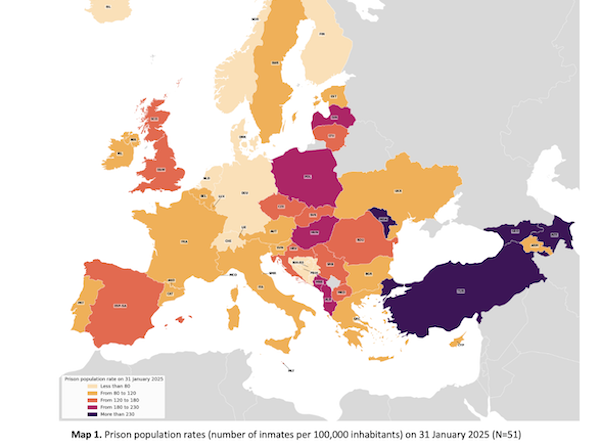
 Prison population rates (number of inmates per 100,000 inhabitants) on 31 January 2025 (N=51);
Credit: Marcelo F Aebi & Edoardo Cocco
Prison population rates (number of inmates per 100,000 inhabitants) on 31 January 2025 (N=51);
Credit: Marcelo F Aebi & Edoardo Cocco
On Tuesday 19 May 2026, the Council of Europe released its 2025 Annual Penal Statistics on Prison Populations (SPACE I), warning that many European countries continue to face serious prison overcrowding and rising prison populations.
The report also highlighted increasing proportions of older detainees and women prisoners across Europe, which, according to data, trends which may create operational and policy challenges to prison systems in the future.
According to the survey, the number of inmates per 100 prison places available in Europe increased from 94.7 to 95.2 between 31 January 2024 and 31 January 2025. Fourteen prison systems in countries with more than 500,000 inhabitants reported having more inmates than available places.
The report identified Turkey and France as the most overcrowded prison systems in Europe, both recording 131 inmates per 100 places, while Croatia followed with 123 inmates per 100 places, ahead of Italy with 121 and Malta with 118. Cyprus followed with 117 inmates, Hungary with 115, Belgium with 114 and Ireland with 112.
Other countries reporting moderate prison overcrowding included Finland, Greece, Scotland, North Macedonia and Sweden, while Romania, Portugal, Azerbaijan, England and Wales, Serbia, Czechia, the Netherlands, Denmark and Switzerland operated at or near full capacity.
As of 31 January 2025, 1,107,921 people were held in custody across the 51 prison administrations of Council of Europe member states. The median prison population rate stood at 110 inmates per 100,000 inhabitants.
The report noted that Luxembourg recorded one of the largest increases in prison population rates in Europe between January 2024 and January 2025, with a rise of 20%. Only Turkey and Montenegro reported larger increases.
Turkey recorded the highest incarceration rate in Europe with 458 inmates per 100,000 inhabitants. Azerbaijan followed with 271 and the Republic of Moldova with 245. Latvia and Poland both recorded rates of 189 inmates per 100,000 inhabitants.
The survey stated that one in four prisoners in Europe was in pre-trial detention in January 2025. Albania recorded the highest proportion of pre-trial detainees at 62%, followed by Montenegro with 53% and Armenia with 52%.
The report stated that non-citizens represented 17% of Europe’s prison population overall. Luxembourg recorded the highest proportion among countries with more than 500,000 inhabitants, with foreign nationals accounting for 78% of inmates. Switzerland followed with 73%, while Cyprus recorded 54%.
The report also highlighted the growing challenge of ageing prison populations, noting that the average age of inmates across Europe stood at 39 years old, with significant variations between countries. According to the survey, the proportion of prisoners aged 65 or over increased from 2.5% in January 2020 to 2.9% in 2025. Croatia recorded the highest share of inmates aged 65 or over at 10.8%.
The proportion of women prisoners in Europe also increased from 4.8% to 5.2% between January 2024 and January 2025, representing an overall increase of 8.9% in countries with populations exceeding one million inhabitants. Hungary recorded the highest proportion of women prisoners at 8.8%, followed by Czechia with 8.6%.
Drug offences remained the most common crimes for which people served prison sentences in Europe at 17.3%, followed by theft at 12.1%. Violent offences, including homicide, sexual offences, assault and robbery, together accounted for around one third of sentenced prisoners.