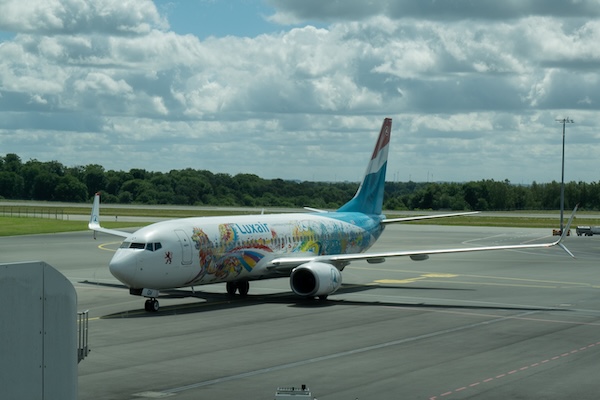
 Credit: Ali Sahib, Chronicle.lu
On Monday 19 January 2026, Luxair issued two statements, including a clarification regarding recent media reports questioning the acquisition and operation of its new Embraer E195-E2 aircraft in connection with temporary operational limitations.
The statement follows the official inauguration, on Saturday 17 January 2026, of the new Embraer E195-E2, with a flight from Luxembourg to Vienna.
Luxair has since reported that referenced limitations do not indicate an error in fleet selection but relate to a wider, industry-wide issue concerning Pratt & Whitney Geared Turbofan (GTF) engines, which are used across multiple aircraft types and manufacturers.
The airline explained that the current measures apply only under very specific meteorological conditions, notably freezing fog combined with extremely low temperatures and poor visibility.
Luxair stressed that the operational limits for the Embraer E2 fleet remain broader and therefore less restrictive than those applied to other aircraft using comparable engine technology, meaning the aircraft does not face disproportionate restrictions in day-to-day operations.
Luxair also addressed recent media references to the precautionary return of an Embraer E195-E2 flight to Luxembourg, confirming that the decision was “purely operational” and unrelated to any engine malfunction or safety incident. “Such decisions are a normal part of responsible airline operations,” it said.The airline elaborated on “safety-driven precautionary decisions” in a separate statement. It emphasised that it operates in an environment where a limited number of flights may return to their departure airport as a precaution following technical or operational indications detected during flight. It added that similar safety-driven decisions are taken every day across the industry, including go-arounds during approach when conditions are not fully within required parameters. Luxair assured that at no time are passengers or crew placed in danger in those cases.
Moreover, the airline stressed that it operates under “a clear safety-first philosophy”, encouraging flight crews to act cautiously and to interrupt or discontinue any flight phase whenever technical or operational indications require further assessment. Modern aircraft use sensitive monitoring systems, multiple layers of redundancy and automated alerts that favour conservative decision-making and ensure that crews address potential issues on the ground rather than manage them in flight.
At the same time, Luxair said it takes extensive measures to limit the impact of such precautionary decisions on passengers, including rapid technical assessments, crew and schedule adjustments, the deployment of spare aircraft when available and close coordination with operational partners.
In 2025, fewer than 1% of Luxair flights were cancelled overall - a figure which the airline said reflected its ability to maintain stable operations while applying conservative safety standards. The airline concluded: “Any decision to return, go around or interrupt a flight is taken with one objective only: the absolute safety of passengers and crew.”