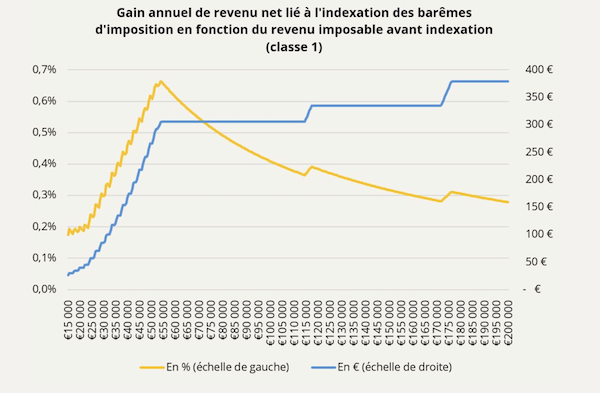
 Annual net income gain resulting from tax bracket indexation by taxable income level before indexation (Tax Class 1);
Credit: ACD; calculations by the author
Annual net income gain resulting from tax bracket indexation by taxable income level before indexation (Tax Class 1);
Credit: ACD; calculations by the author
On Friday 12 June 2026, Luxembourg think tank IDEA published two analyses examining the tripartite agreement signed on Monday 8 June 2026, focusing on the government's Resilienzpak measures and the temporary tax credit introduced as part of the package.
The analyses, written by economist Frédéric Meys and IDEA Director Vincent Hein, address four key questions: the impact of the Resilienzpak on the energy transition, whether the measures support purchasing power and help curb inflation, whether the agreement reflects lessons learned from the 2022-2023 energy crisis, and who ultimately benefits from the temporary tax credit.
Regarding the energy transition, IDEA argued that the Resilienzpak sends an unfavourable signal by supporting fossil fuels, although the scale of that support should be put into perspective. According to the analyses, the measures do not fundamentally alter the economic rationale for electrification, while support for electricity remains significantly higher than for fossil fuels.
On purchasing power and inflation, IDEA noted that broad-based price measures are effective in slowing inflation because they directly affect the consumer price index and can delay future index-linked wage adjustments. However, the think tank argued that such measures are less effective at targeting households most affected by rising energy prices, as they also benefit higher-income households and non-resident consumers purchasing fuel in Luxembourg.
Regarding lessons from the 2022-2023 energy crisis, IDEA observed that the temporary nature of the measures mirrors previous support packages, which were also initially time-limited before being repeatedly extended. The think tank suggested that the real test of budgetary discipline would come if market pressures persist beyond the end of 2026.
In his analysis of the temporary tax credit, Vincent Hein argued that while the indexation of tax brackets can be justified as a way of addressing fiscal drag affecting middle-income earners, its social targeting remains limited. Given the measure's budgetary cost of €190 million out of the Resilienzpak's €430 million envelope, he suggested that a more progressive tax credit targeted at vulnerable households could have achieved the objective more effectively.
The full analyses, available in French on IDEA's website, are titled "Resilienzpak: Three Questions on the Tripartite Agreement of 8 June 2026" by economist Frédéric Meys and "Who Benefits from the Temporary Tax Credit?" by IDEA Director Vincent Hein.